

Video translation projects hold enormous potential for global reach, yet they consistently derail from budget and cause delays because standard AI systems attempt to handle complex audiovisual demands with general-purpose models.
The results are often poor transcription accuracy, unnatural dialogue, timing mismatches, and editing costs that spiral out of control.
In response, Ollang offers multiagent AI for video translation that tackles both quality demands and cost pressures of subtitling and dubbing. In this approach, instead of forcing one model to handle everything, AI agents tackle distinct translation challenges.
What challenges does audiovisual translation present?
Video translation requires alignment across various tasks that single AI models weren't designed to handle.
Subtitle translation demands precise condensation to fit screen space and reading speed constraints while preserving meaning, tone, and cultural context. Most AI systems either maintain accuracy and exceed character limits, or stay within limits while diluting the message.
Dubbing projects require translations that match lip movements and character personalities to create natural viewer experiences. Standard models translate for meaning but ignore the phonetic patterns and expressive tone that make dubbed content believable.
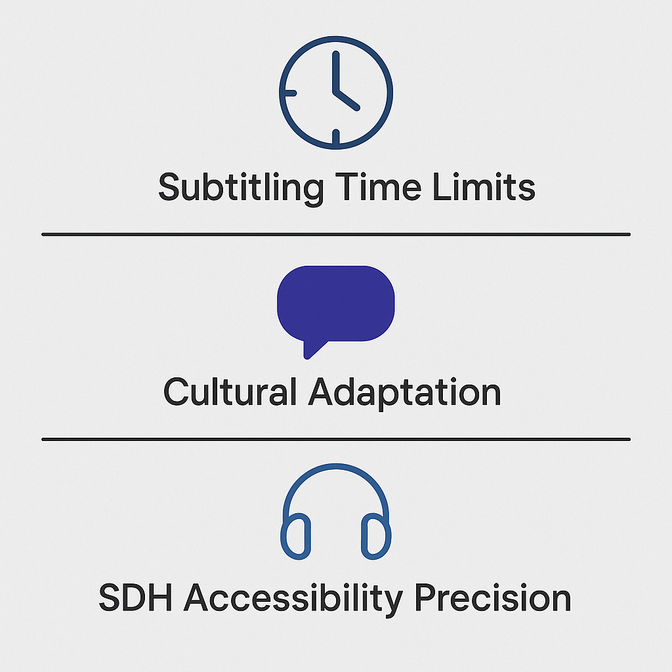
Standard AI struggles with cultural nuances that determine content success in local markets. Comedy shows lose their humor when wordplay gets translated literally. Documentary technical jargon becomes incomprehensible when AI lacks domain knowledge.
Accessibility adds regulatory complexity that standard AI ignores. The European Accessibility Act, for example, mandates precise Closed Captions and Subtitles for the Deaf and Hard of Hearing, requiring accurate transcription and audio descriptions beyond dialogue. Single AI models consistently fail these technical requirements.
Translating video with Multiagent AI to get superior results
Multiagent AI translation assigns task-oriented artificial intelligence agents to distinct workflow stages.
Each agent combines Large Language Model capabilities with specialized training for specific subtasks. One agent focuses on speech-to-text transcription in noisy audio environments. Another handles temporal alignment between translated text and on-screen action. Cultural adaptation agents access localized databases and industry glossaries to ensure content resonates with target audiences.
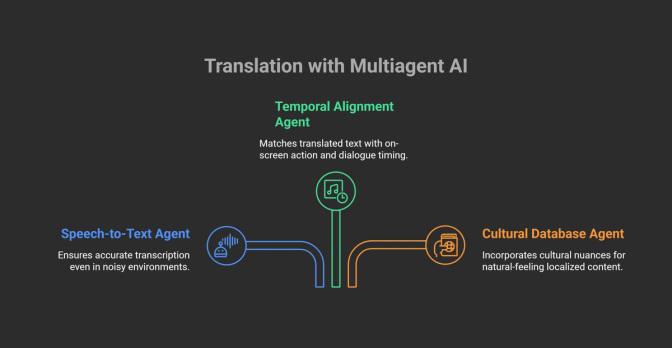
This division of labor mirrors human localization workflows while maintaining AI-powered scale and speed.
Ollang's multiagent AI, detailed in our technical white paper, uses tailored agents for transcription, translation, and quality assurance. This focused approach handles multimodal content complexity that monolithic AI cannot replicate consistently.
What benefits does Multiagent AI bring to subtitling and dubbing?
Multiagent AI systems deliver quantifiable improvements in transcription accuracy, translation quality, and project economics compared to standard approaches.
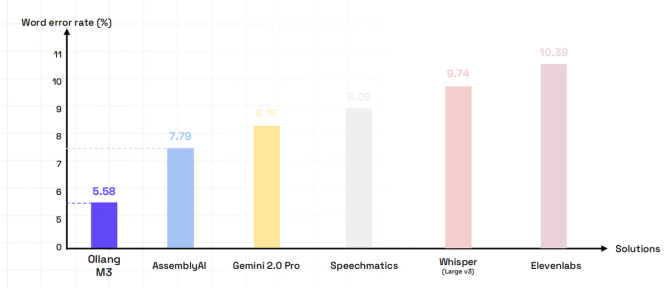
Testing with 10 minutes of animated content revealed Ollang's multiagent system achieved a 5.58% Word Error Rate for speech-to-text transcription. Competitive solutions showed significantly higher error rates:
⚫ Speechmatics: 7.79%
⚫ Elevenlabs: 10.39%
⚫ Other major platforms: 8-10% range
Lower transcription error rates compound throughout entire projects. Fewer errors mean less manual correction time, faster delivery schedules, and reduced project costs.
Translation accuracy improvements prove even more dramatic. Our multiagent approach applies self-correction protocols and learned linguistic rules to reduce translation errors by over 60% compared to single-model systems. This precision creates measurable business value across production workflows.
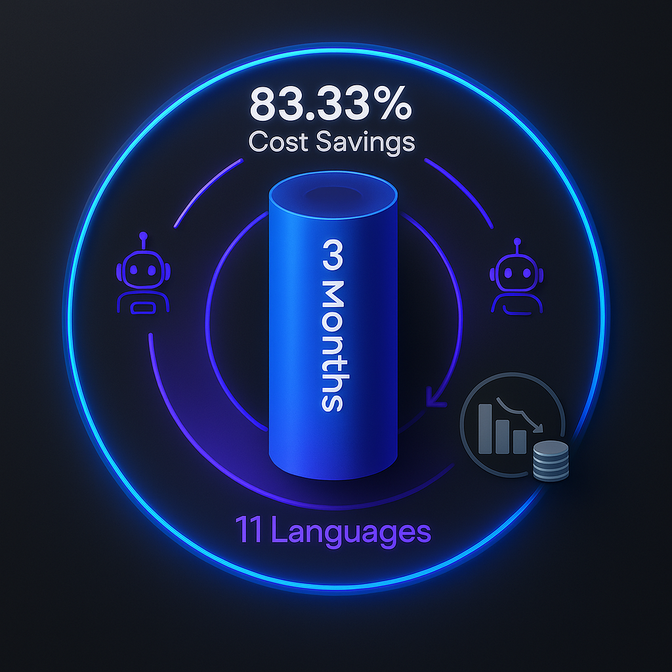
A video streaming platform used our multiagent approach to localize 10,000 short videos totaling approximately 20,000 minutes. They achieved over 80% cost savings compared to previous workflows that required extensive human editing of standard AI output.
These savings result from targeting human expertise precisely where machines struggle while eliminating tedious correction work. Companies can now scale multilingual content production more effectively that weren't viable with previous methods.
Multiagent AI localization drives global business expansion
Multiagent AI systems handle diverse content types from feature films and series to corporate training videos and gaming content. This versatility means localization supports business expansion rather than constraining it through technical limitations.
The economic transformation extends beyond cost reduction. Faster turnaround times accelerate time-to-market for global releases. Higher translation quality improves audience engagement metrics and reduces negative feedback. Compliance with accessibility standards opens new market segments while meeting regulatory requirements.
Streaming platforms can now pursue international markets that were previously too expensive to justify. Educational companies can localize training materials across multiple languages simultaneously. Gaming studios can support global launches without sacrificing quality or timeline commitments. The possibilities are vast.
To find out more about multiagent AI translation, browse our blog posts, and see examples in our case studies.
Connect with our partnerships team when you're ready to discuss your content.