


Today’s mostly hybrid and on-the-go students and employees find e-learning platforms and online courses quite accessible and convenient ways to acquire new knowledge and improve their fields of expertise. This has led to a meteoric growth in the edtech industry, while the number of educators (course creators) and e-learning platforms is showing a continuous increase. How would you ensure that your content stands out from your competitors and holds the learners’ attention?
Making your content informative and engaging is important. Some powerful methods include curating your content in bite-sized and easily digestible formats (mostly as videos), providing mini assignments, and using Artificial Intelligence for a more personalized experience. Moreover, you should ensure that your content does not get lost on the global scale. By localizing your courses to other languages, you can overcome language barriers and reach audiences internationally.
With English being accepted as the most widely-spoken language in the world, most e-learning providers tend to render their online courses only in English. However, according to Ethnologue, of 1,453 million speakers of English, 373 million are native speakers while 1,080 million speak English as their second language. Lack of access to content in native languages may cause learners to feel disengaged and impair learning experiences.
Rapid Growth and Evolving Trends
According to Straits Research, the global e-learning market was worth $215 billion in 2021, and it is projected to reach USD 645 billion in market size by 2030, growing at a CAGR of 13%. Why has it become so popular? First of all, it typically requires 40 percent to 60 percent less time to study a particular material online as compared to traditional learning environments. Also, you do not need to commute or rent spaces. The freedom of studying anywhere, anytime is another benefit. Lastly, another added benefit is to increase reachability thanks to creation of online learning content in multiple languages.
E-learning Localization

Transcribing, closed-captioning, subtitling, and dubbing are different methods of content localization. Which one works best for you mostly depends on your budget, target audience, and subject matter of the content. However, each way enhances accessibility and reachability by creating more personalized learning experiences.
After reading the rest of this article, you will get a brief overview of the e-learning space with key statistics, better understand the correlation between accessibility and multilingual content creation, and learn the most effective methods of e-learning globalization. Before going on with the next section, we highly recommend you to look at the key terms and definitions we shared here.
Localization as a Way to Boost Accessibility
You should know that different expectations come into play where accessible learning is concerned.
For people with disabilities such as those who are hard of hearing or who struggle with dyslexia and ADHD, closed captions or subtitles in the same language may already be sufficient if they speak the same language provided in the content. By creating inclusive e-learning platforms and online courses, you also stay compliant with the requirements of laws and regulations such as the Americans with Disabilities Act of 1980, the Rehabilitation Act of 1973, and the 2008 amendments to the ADA.
For non-native speakers, you need to translate audio-visual materials into their native languages. Subtitles and dubbing are two powerful ways to achieve this.
Your enroller base may need both monolingual and multilingual subtitles as well as closed-captions. Some people learn better when they see verbal content in text format and use written materials to help them digest what they see in videos. Machine-aided transcripts may be the first stage of your e-learning globalization project. When you partner with a company that offers AI-powered globalization solutions, you can easily broaden the reach of your content with closed-captioning, subtitling, and dubbing.
How to Localize E-learning Materials?
Localizing content may turn into a daunting job if you do not decide upfront where to start, which methods to use and how much of your content to make reachable in different languages. By partnering with globalization solutions professionals, you can simplify your localization projects and connect with learners worldwide easily.
We use closed captions, subtitles, and dubbing powered by AI at Ollang, in addition to machine-aided transcription services, to enable you to narrate learning experiences in the most humanized and accessible way possible. Let’s discuss them in brief, with a focus on key differences.
- Machine-aided transcripts
Transcripts cater to the needs of people who are hard of hearing. They also come in handy for those who look for written material to look up a word they cannot capture in the recording or to use as a source of reference.
Creating transcripts with machine-aided solutions is quite easy, fast, and cost-effective. Moreover, when you decide to take your globalization project to the next level with subtitles or captions, you will have a written version of your audio-visual content at hand. Another advantage is that when you support your recordings or videos with written scripts, you allow Google crawlers to "read" your content, understand the type of course you offer, and lead potential students and buyers to your courses.
- Closed-captions and subtitles in multiple languages
Closed captions are the text versions of the spoken part of a video and are displayed on the screen in synchrony with the visual content. It is similar to monolingual subtitles in this sense; however, it provides the viewer with additional explanations as to what’s happening in the background. That’s why closed captions are preferred over monolingual subtitles (which do not explain audio details) by people who are hard of hearing.
In sound-sensitive environments where the audio volume should be lowered, captions serve as a useful tool. Also, those who are not native speakers of the source language of the video can benefit from captions to strengthen their language skills. Captioning comes with a number of benefits and offers a win-win situation for both learners and e-learning providers. Moreover, AI-powered software offers hassle-free processes while ensuring the most accurate, fast, and quality captions at lower prices.
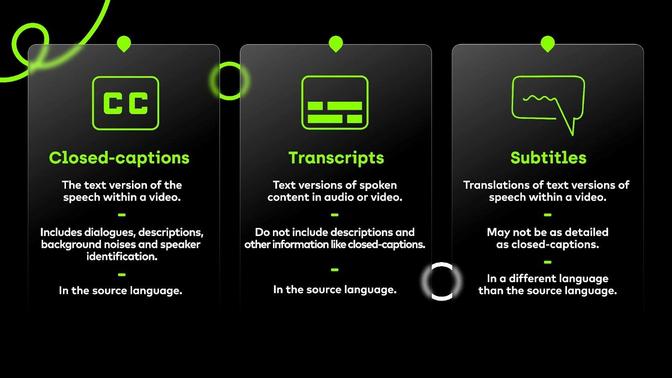
If you want to expand your outreach beyond borders, you need subtitles in multiple languages. Subtitles help increase knowledge retention and learn new languages. At Ollang, we use an AI-powered subtitling software to streamline your workflows in the most efficient and accurate way at lower prices and with quicker delivery times. Human touch is a part of our operational process that is non-negotiable, and a select group of seasoned translators always check and revise the raw output produced with machine translation.
- Voiceover and dubbing
Voiceover is a form of dubbing and primarily used for videos with a lot of on-screen text or multiple speakers. It differs from lip-sync dubbing in that it does not match with the speaker’s lip movements. Although it is cheaper and faster than lip sync dubbing, the latter provides a more relatable audio component and prevents any distraction that may be caused by the mismatch between dubbed sound and the lip movements of the speaker.
With Ollang’s AI dubbing tool, we help you overcome the barriers put up by traditional dubbing, which requires the full participation of human voice actors. The advancements in artificial intelligence technology make it possible to dub videos faster and more cost effectively. Processes we undertake at Olabs aim to create the most natural, human-like AI-powered voices, thus making it easier to create connections between your content and learners.
4 Things to Know Before Starting Your E-learning Localization

These factors will help you make an informed decision and draw a solid roadmap for localizing online course materials.
-Transcripts, closed captions, or (monolingual) subtitles customize your content for learners who speak and understand the source language of your course materials. However, as mentioned above, closed captions guarantee more inclusive experiences than the other two solutions. Also, laws may require you to offer closed captions for people with certain disabilities.
-Adapting e-learning content to multiple languages grows your business. It is key to breaking the language barriers and creating learner-centered, region-oriented materials. You maximize the value of your existing content and reach students all over the world with multilingual content creation.
-Making a choice between subtitling and dubbing depends on the type of content, the targeted markets, and the budget. For example, while dubbing is more common in Asia and many parts of Europe, subtitles appeal more to people in the Nordic countries. Lip-synch dubbing offers the most engaging experience in most cases, and if you are worried about prolonged delivery times or high production costs, we recommend you to try AI-powered dubbing solutions.
-You may be unsure which language or languages you will localize your content to. This article listing the most spoken languages worldwide may help you draw your path towards expanding into international markets. Keep in mind that while North America dominates the regional market, Asia-Pacific is expected to be the fastest-growing region, with a projected value of USD 80 billion by 2030 at a CAGR of 18.1%.
Connect With Your International Audiences
The estimated number of people speaking English worldwide is 1.5 billion, including those who use it as a second language. That’s only 17% of the world’s population. If your goal is to make your courses accessible and engaging for everyone, not just those who speak English as their first language, then you should remove the roadblocks facing international users and ensure your content speaks to people in their own or preferred language.
To help people achieve their learning goals without being excluded due to the language they cannot speak or understand, weigh out the localization options you have by considering the 4 factors mentioned above. Also, you can always discuss with us the best strategies you can use to globalize your content and get introduced to our AI-powered solutions offered through Olabs.