

With the European Accessibility Act (EAA) mandates set for June 28, 2025, compliance becomes urgent. The EAA emphasizes accessibility, with a particular focus on Subtitles for the Deaf and Hard of Hearing (SDH) and Closed Captions (CC).
The regulation impacts the localization industry by requiring content adaptation for specific markets through language translation and cultural adjustments.
It opens up broader audience access for content owners, such as streaming platforms and filmmakers under tight schedules, when paired with scalable solutions.
Limits of Traditional Approaches
Traditional machine translation persists, backed by company investments, yet it has limits.
Without human-in-the-loop (HITL) oversight, quality drops, costs climb, and scalability weakens.
Regulatory restrictions, like HIPAA in the U.S., add complexity for patient-related translations. Medical records, prescriptions, or clinical trial documents all require encryption, secure storage, and restricted access. Non-compliant machine translation and LLMs fall short in these cases.
A Path Forward
Ollang’s Agentic AI provides a solution. It delivers precise, culturally relevant CC and SDH across large volumes, meets EAA standards, and improves workflows.
This article reveals how content owners seize control and meet regulatory demands with efficiency.
The Accessibility Imperative: SDH and EAA Mandates
The urgency outlined above stems from strict EAA requirements. Public sector bodies and key private companies must deliver CC and SDH that reflect dialogue and critical audio cues, such as “[rain patters],” “[door creaks],” or “[Sara, whispering]: I’m here.”
SDH surpasses standard subtitles by delivering a complete audio experience for deaf and hard of hearing viewers, incorporating emotion and context vital for comprehension. Broadcasters need to adapt to this scale to retain viewers.
Non-compliance risks fines, yet compliance taps a vast audience. Ollang’s solution effectively addresses this challenge.
How Ollang’s Agentic AI Delivers
Ollang’s multiagent system excels with precision. Specialized AI agents collaborate, adapt, and learn from each project dynamically to refine outputs in real time. This approach, developed through iterative advancements, increases accuracy across text, audio, and video formats to serve global enterprises.
Unlike traditional tools that rely on single-model frameworks, Ollang deploys a multilingual, multimodal, multiagent AI architecture. Each agent handles a distinct task to ensure comprehensive localization that meets the EAA standards for CC and SDH.
The Video Understanding Agent analyzes content through scene segmentation and speech-to-text transcription with computer vision APIs and memory systems to track recurring elements.
The Cultural Adaptation Agent adjusts these cues to suit target audience norms with cultural databases and sentiment analysis to avoid misunderstandings.
The Multimodal Judge Agent evaluates text, audio, and video alignment and achieves a localization accuracy of 98.9% for German in benchmark tests.
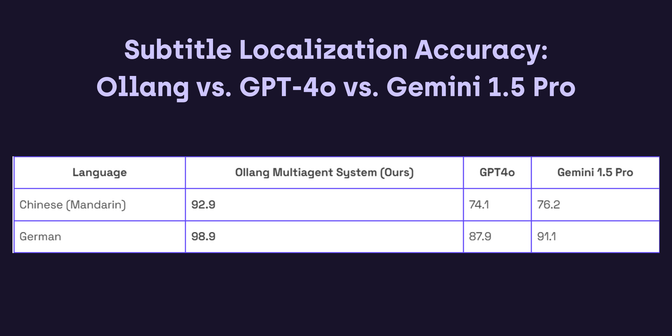
This surpasses GPT-4o at 87.9% and Gemini 1.5 Pro at 91.1%. The result reflects greater correctness of translated content compared to reference standards. (For more information, you can read the whitepaper authored by Ollang’s product engineers.)
Key Benefits
⇾ In-depth Contextual Understanding: Agents analyze languages thoroughly, ensuring natural, context-appropriate SDH.
⇾ Cultural Relevance: Translations suit local audiences and avoid cultural missteps.
⇾ Format Precision: Text, audio, and video align seamlessly to meet EAA standards.
⇾ Efficiency: Less human intervention speeds up timelines.
Ollang meets accessibility-focused localization demands. Its accuracy captures every sound and sentiment, which reduces translation errors by over 60%.
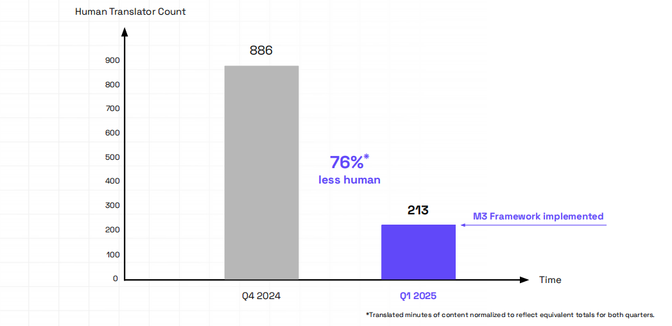
Speed remains critical to meet tight EAA deadlines, and the M3 framework supports this by reducing human involvement by 76% and shortening localization turnaround times significantly.
These advantages support diverse industries under EAA compliance requirements.
Industries Impacted by EAA and SDH Requirements
The EAA affects multiple sectors who need SDH and regulated CC.
⇾ Media and Entertainment: Streaming platforms, filmmakers, and broadcasters generate extensive video content, including shows, movies, and live broadcasts. Accurate SDH and CC are essential to make this content accessible to all viewers.
⇾ Technology and SaaS: Companies in this sector produce video tutorials, webinars, and product demos. Accessible captions make these resources available to users with hearing impairments.
⇾ Retail and E-commerce: Online retailers rely on videos for product descriptions, advertisements, and customer support. SDH and CC enable broader customer reach and inclusivity.
⇾ Banking and Finance: Financial institutions create training videos, customer service recordings, and compliance-related content. Accessible captions support both internal training and external communications.
⇾ Marketing: Marketing teams develop video campaigns to engage diverse audiences. SDH and CC ensure these efforts are inclusive and meet regulatory standards.
⇾ Manufacturing: Manufacturers produce training materials, safety videos, and product demonstrations. Accessible captions enhance workforce training and safety compliance.
⇾ Education and eLearning: Educational platforms deliver video-based lectures and courses. SDH and CC make learning materials accessible to all students.
Ollang equips these sectors with compliant, scalable solutions. Content owners gain confidence. A filmmaker expands releases, or a platform targets EU markets, with accessibility delivered simply.
Why Agentic AI Stands Out
Localization workflows commonly employ Neural Machine Translation (NMT) and Large Language Models (LLMs) to automate translation tasks. However, these standard methods have limitations, particularly when addressing the nuanced requirements of EAA-compliant SDH.
NMT struggles with audio context and cultural nuance, producing literal translations that miss idiomatic expressions or non-verbal cues like “[door slams].”
LLMs generate fluent text and grasp context in simple cases, yet they err with rare languages, over-adapt, and fail to coordinate text, audio, and video without heavy oversight. These limitations increase costs and delays.
There is a gap between multilingual and multimodal applications of the multiagent systems. This is what Ollang has solved.
Our system uses task-specific agents, each addressing a unique localization aspect, from video analysis to cultural adaptation.
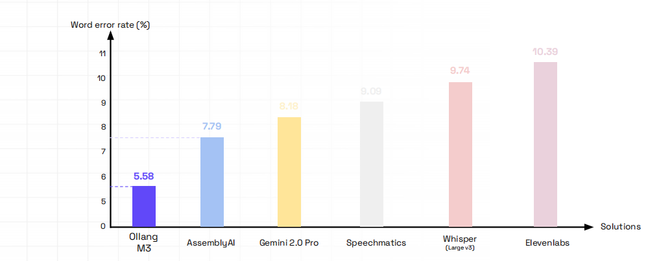
The M3 (Multilingual Multimodal Multiagent) Framework drives this modular design to solve challenges single models cannot. Ollang’s 5.58% WER for speech-to-text (transcription) technology outpace competitors. Dynamic model selection adapts to language complexity and maintains accuracy where LLMs struggle with low-resource languages.
Feedback loops with critic agents refine outputs instantly, a step NMT and LLMs skip. The Multimodal Judge Agent aligns “[glass shatters]” with video, a task beyond standalone models.
This precision ensures EAA-ready SDH.
Accessibility as a Strategic Advantage
The EAA presents an opportunity beyond compliance. Ollang’s precision exceeds traditional tools, cuts errors by 60%, and speeds delivery for 2025 deadlines.
These strengths deliver results. Streaming platforms reduce costs, filmmakers scale quickly, and localization teams operate smoothly.
With Ollang, you can capture every audio cue, engage every viewer, and prepare your content for global markets.
Get a demo from Ollang to see how it applies to your goals.