

Let’s not beat around the bush and lay the facts bare: No platform or content distributor is replacing one another. Rather, they are evolving into spaces where audiences can find hybrid models for engaging audiovisual content.
While YouTube is not likely to become the new Netflix, it is making strides by launching new channels and subscription models such as YouTube Premium, YouTube Primetime Channels, and FAST Hub. The availability of a variety of content on a single platform is turning the balance upside down and influencing the future of the streaming media and content localization.
Millennials have been the driving force behind the growth of video streaming platforms so far. But, according to Deloitte's latest Digital Media Trends report, they may be experiencing subscription fatigue. That’s why they are looking for more cost-effective options, whether it be through subscription-based platforms (SVODs) or advertising-supported platforms (AVODs).
The crucial question is, then, how can video streaming platforms sustain their growth without losing their current subscriber base? Will younger generations stick to SVODs or switch to streaming TV shows and movies on alternative digital platforms?
Generations Differ in Viewing Habits: A Key Disruptor in the Digital Media
Deloitte’s analysts don’t paint the devil on the wall: People are not turning back on their favorite SVODs. What we have is that younger generations are more conscious of the options they have, and different kinds of values that these options offer, such as utility, community-building, social interaction, and cost-effectiveness, shape their decisions.
With that being said, half of millennials and Gen Z respondents in Deloitte’s survey prefer user-generated content to video streaming platforms. UGCs are popular among respondents because they are free to watch, appeal to a wide variety of interest areas, and they are convenient to watch on both computers and mobile devices. This shift has led to a new war: The competition in the video streaming market is no longer restricted to the SVOD giants themselves. It has expanded to include social media platforms, particularly YouTube, in the race to attract more viewers.
Strategic Moves From YouTube to Become ‘Video’s Everything App’’
Ben Woods from Midia Research suggests that YouTube is gradually becoming an everything app for the video industry. To achieve this, it adopts a strategy that enables it to extend its digital footprint well beyond social video content into a style that merges subscription on demand with free, ad-supported streaming for users.
↠ Back in March 2022, YouTube added to its existing catalog around 4,000 free, add-supported TV shows for US viewers. At that time, the platform had already housed more than 1,500 free, add-supported movies from major partners such as Disney Media & Entertainment Distribution, Warner Bros., and Paramount Pictures. Its subsequent investment in the TV shows can be regarded as the next stage of its expansion into long-style, studio-based video content.
↠ A few months later, in the last quarter of 2022, YouTube announced a Primetime Channels feature that provides access for viewers to subscribe to 30+ streaming platforms, including Paramount+, Showtime, Shudder, Starz, AMC+ and more.
↠ In January 2023, users in the US learned that they were now provided with a featured hub on the video platform through which they could reach free, add-supported (FAST) channels. According to reports, this dedicated space will offer FAST content from partners such as A+E Networks, Cinedigm Corp., Lions Gate Entertainment Corp., and FilmRise following the initial testing stage.
YouTube aims to be the single destination for viewers for all their favorite content, ranging from creator videos to movies, TV shows, documentaries, sports, educational courses, and more. YouTube’s ambitious moves are likely to impact decisions about canceling SVOD subscriptions, which is known as the churn rate.
Rising SVOD Churn Rates: How to Retain Subscribers
Deloitte analysts asked respondents whether they had canceled any one of their subscriptions within a 6-month period. Across all generations, the churn rate for paid SVOD services was 44%. The numbers hit 57% and 62% for Gen Z and Millennials, respectively. It is interesting to see that around a quarter of subscribers have ‘churned and returned’ to renew their subscriptions, with younger generations again accounting for a larger share.

Credit: Trent Joaquin; Adweek
SVOD services should develop strategies to retain existing subscribers. If the churn rate remains high, subscriber growth is more likely to be "one step forward, two steps back," according to Eunice Shin, a partner at strategy consulting firm Prophet. Investments in new content production are still the strongest card that services have, but "The race to continue to add customers by commissioning and acquiring really high-cost content will not succeed on its own," says Kevin Westcott, Deloitte’s U.S. technology, media, and telecom leader. That may explain why service providers have begun investing more to produce local language original programs and then offering them to international markets via subtitles and dubbing.
AI-Enabled Subtitling and Dubbing: The Competitive Advantage Content Owners Need
Content production remains the major factor influencing viewing habits and users’ engagement. SVODs are expected to continue investing in the original programming and internationalization of both the local language of the original title and English content by using solutions such as closed captioning, subtitles, and dubbing.
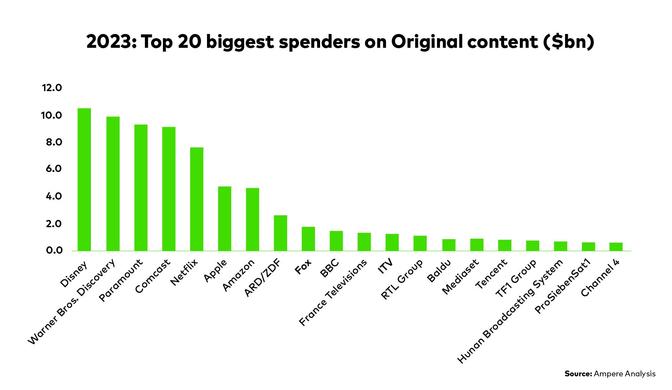
Original TV content spending growth is expected to continue in 2023
Statista’s analysis is in line with the numbers in the chart above, ranking Disney as number one among global video streaming companies that will invest in original programming. According to this analysis, Netflix ranks fifth, but with a share of over 25 percent, the streaming behemoth is expected to spend the most on original content worldwide. The number of titles being released on various platforms is increasing, resulting in a growth in demand for localizing such content into other languages. M&E companies need competitive methods that allow them to enter global markets faster and at reduced costs while at the same time ensuring high quality and accurate localization.
Teresa Philips from Spherex argues for utilizing AI and ML tools to automate and accelerate manual processes. Technology can be used to simplify and scale aspects of localization that heavily depend on human effort. AI-powered closed-captioning, subtitling, and dubbing handle the initial stage of the process, providing a highly accurate version of the text or audio in the target language and thus freeing human translators from repetitive, monotonous tasks.
As an example, Netflix benefits from AI-enabled tools to provide closed captions and subtitles for international viewers and partners with third-party localization solution providers such as Ollang to streamline workflows for different stages of the process.
Boosting SVOD Reach: Localization Can Help Expand
With hundreds of titles waiting to be adapted for international markets, SVODs adopt a mechanism that runs on two fronts. The first of this system is the localization of English content for non-English speaking countries. Today, almost 90% of the titles being released in international markets are still in English. Therefore, depending on the viewing habits of the countries, services are commissioning localized content in different languages. Netflix offers subtitles in as many as 37 languages and dubbing in up to 34 languages.
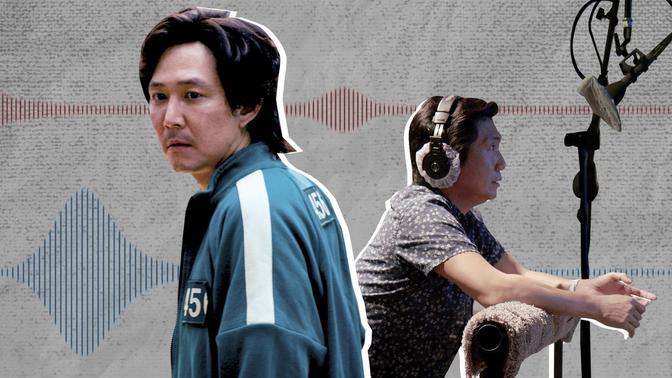
Photo Illustration: Sharon Shi; The Wall Street Journal
The second front of the said localization mechanism adopted by SVODs is to subtitle and dub non-English content for English speaking countries. Netflix’s South Korean dystopian series Squid Game and French crime drama series Lupin are two examples that gained popularity outside of their local markets. “Younger demographics who are increasingly enjoying watching subtitled and dubbed content” plays an important role in increasing the number of high-budget and quality original titles, according to Hannah Walsh, a research manager at Ampere Analysis.
In larger markets, such as Japan, Netflix offers dubbing for 40% of its content while nearly all titles have closed-captioning and subtitles. Viewers in European markets can watch 60% of Netflix productions with dubbing. However, when it comes to countries with a smaller market penetration, such as Russia and Turkey, we see a more prudent approach. In the case of Netflix, the share of the titles being localized for such countries is between 13% and 28%; however, this is expected “to change as market penetration grows,” according to Tingting Li, another analyst from Ampere Research.
Final Remarks
As we argued at the beginning, SVODs cannot underestimate the threats posed by YouTube’s strategic moves to turn itself into a single destination for every video content and should address high churn rates. A sustainable and solid growth is only possible if they gain user’s loyalty to the platform. Offering shows and movies with subtitles and dubbing in multiple languages is a fail-proof way to engage global audiences.
With the current talent crunch in the localization industry, embracing AI-powered technologies can be a lifesaver for M&E companies seeking to meet the high demand. AI accelerates content production and decreases costs but it should not be solely relied on for localization. Human editors and translators should refine translations and voicing generated by AI for higher quality.
Besides offering multilingual content, platforms can benefit from strategies below to address the challenges they’re facing due to high cancellation rates.
↠ Media landscape is now more interdependent than ever. Establishing partnerships with other content providers pays off by opening up opportunities to reach and engage a wider audience.
↠ Secondly, SVODs can offer cost-sensitive options to subscribers by subsidizing prices with ad-supported tiers. Major subscription on demand platforms have already launched add-supported tiers, and can enhance their models with relatable advertising to retain and attract new users.
↠ Thirdly, partnering with creators and influencers on social media can help service providers promote their content, as over half of all consumers and nearly three-quarters of Gen Zs and Millennials watched a show or movie on an SVOD platform after seeing recommendations on social media.
Content providers cannot afford to underestimate the value that their platforms will gain when they establish stronger bonds with younger generations through social, authentic and interactive content.