
Most translation projects fail because companies choose AI technology based on marketing promises rather than actual performance requirements. The difference between standard AI, generative AI, and multiagent approaches determines whether your subtitles make viewers cringe or keep them engaged.
What is Standard AI translation, and how does it work?
Standard AI translation evolved through three distinct phases, each solving previous problems while creating new ones.
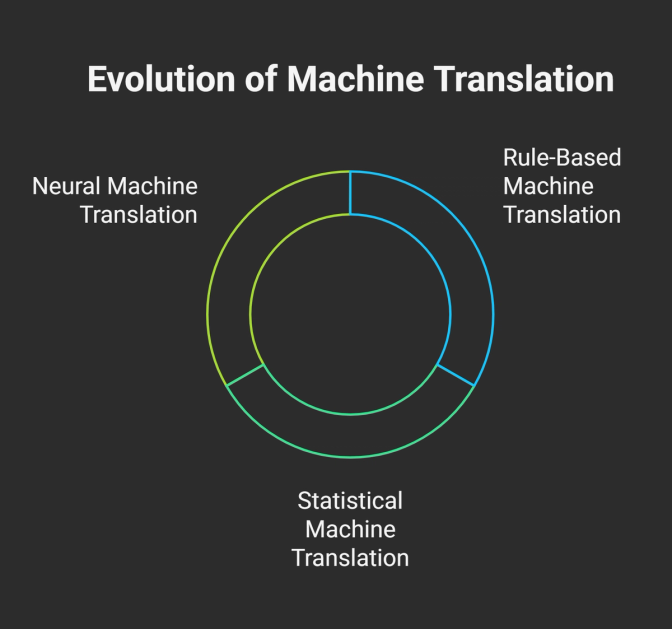
Rule-Based (RBMT):
Relies on hard-coded grammar rules and dictionaries. While predictable for simple sentences, it transforms idioms into meaningless literal translations. "Break a leg" becomes advice for bone fractures instead of encouragement.
Statistical (SMT):
Learns from bilingual text collections to predict common word patterns. The approach fails spectacularly with complex syntax structures. Consider this Turkish translation:
Original: "The documentary I watched yesterday was fascinating."
SMT Output: "Belgesel ben izledim dün ilginçti."
The jarring word order creates awkward timing issues that clash with lip movements and visual scenes in dubbed content.
Neural (NMT):
Applies deep learning for smoother phrasing but still misses cultural nuances that matter for audience engagement. German "Feierabend" represents the clear boundary between work and leisure time, a concept with deep cultural significance. NMT flattens this to "evening off," losing the meaning entirely.
LLMs in Translation: When Does Generative AI Make Sense?
Large language models like ChatGPT improve translation fluency compared to standard methods through better contextual understanding. However, professional localization reveals critical gaps:
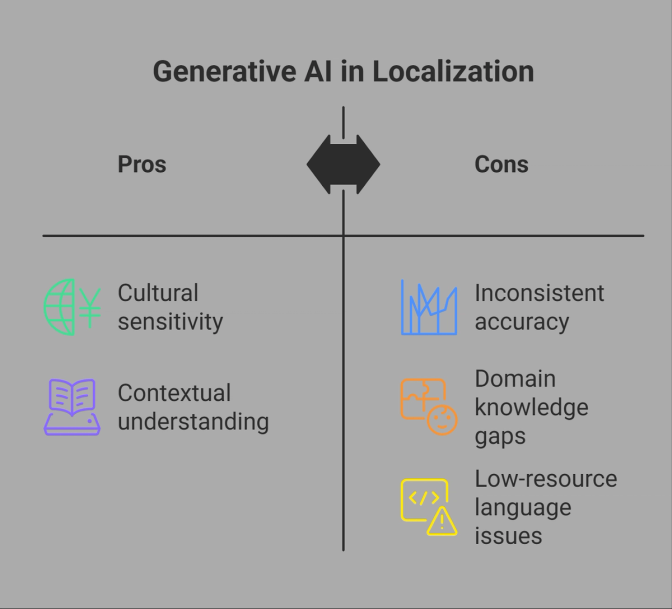
LLMs still face significant limitations:
‣ Inconsistent accuracy and biased translations
‣ Domain-specific knowledge gaps in technical or cultural contexts
‣ Poor performance with low-resource languages.
Consider this English-to-Russian translation scenario from a dating app:
Original: “You’re their type!”
First pass: “Ты в его/её вкусе!” (“You’re his/her type!”)
After feedback: “Ты — чья-то мечта!” (“You’re someone’s dream!”)
LLMs require multiple feedback rounds and expert oversight to achieve professional quality. They function as useful components within larger workflows rather than standalone solutions for enterprise localization needs.
How Multiagent AI Solves Translation Workflow Problems
Multiagent AI ssigns specialized tasks to dedicated AI models within the translation pipeline:
‣ Speech Recognition agents generate accurate transcripts
‣ Context Analysis agents identify cultural references and tone
‣ Translation agents handle language transfer with domain expertise
‣ Quality Control agents ensure formatting, timing, and length requirements
The difference becomes clear in subtitle translation results. Consider this Italian dialogue:
Original:
A: “Gemma non è il massimo, però… mi sembra si stia sforzando ad essere gentile con me.”
B: “È tutta una recita! Il suo piano sta funzionando.”
A: “Irene, ma che cosa può succedere se io e Gemma andiamo d’accordo?”
LLM translation:
A: “Gemma isn’t the best, but it seems she is forcing herself to be kind to me.”
B: “It’s all a play! Her plan is working.”
A: “Irene, but what can happen if Gemma and I get along?”
Multiagent translation:
A: "Gemma’s not the greatest, but she’s trying to be nice to me."
B: "It’s all an act! Her plan’s working."
A: "Irene, what’s the harm if Gemma and I get along?"
The LLM version produces wordy, literal phrasing with stiff idioms that ignore subtitle length constraints. The multiagent approach delivers natural dialogue with proper line breaks and character limits for screen display.
Performance Data: Multiagent AI Accuracy in Real Projects
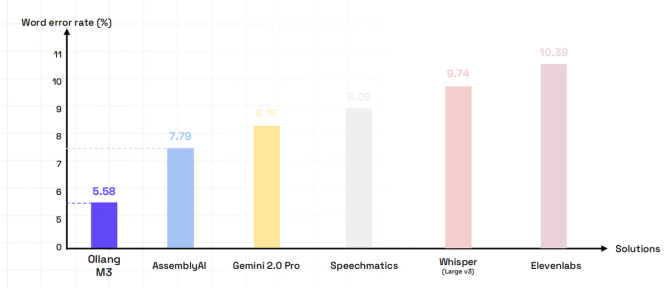
Ollang's multiagent system demonstrates measurable improvements in speech-to-text accuracy for audiovisual content. Testing on an animated feature revealed a 5.58% Word Error Rate compared to:
⁃ AssemblyAI: 7.79%
⁃ Gemini 2.0 Pro: 8.18%
⁃ Speechmatics: 9.09%
⁃ Whisper (large v3): 9.74%
⁃ Elevenlabs: 10.39%.
Lower error rates directly reduce human editing time for continuous localization of series and documentaries, which creates measurable ROI improvements and better audience engagement.
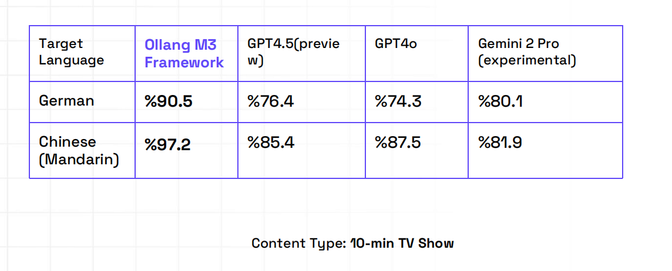
Subtitle translation accuracy tests show similar patterns. Ollang's multiagent system achieved 90.5% accuracy in German subtitle translation versus 74.3% from GPT-4o when evaluated on identical TV show content with consistent criteria.
Choosing the Right AI Translation Approach for Your Content
Standard AI: Works for literal, low-complexity scripts but requires extensive post-editing that increases project timelines and costs.
Generative AI: Produces fluent output but struggles with timing constraints, formatting requirements, and specialized terminology that audiovisual content demands.
Multiagent AI: Replicates human localization workflows through specialized agents, delivering context-aware, subtitle-ready translations that scale with enterprise requirements.
The technology choice determines three critical business outcomes:
‣ Turnaround times for getting content to market
‣ Total project costs including editing and quality assurance
‣ Translation precision across diverse content types and languages.
Content owners, streaming platforms, and enterprises that select appropriate AI translation technology achieve faster localization cycles while maintaining quality standards that preserve audience engagement across global markets.
For additional insights, explore Ollang's blog posts and case studies available on our website.
Contact our partnerships team for customized solutions and pricing.