


Within the e-learning landscape, it has become more of a norm for platforms and course creators to tailor their content to diverse languages. Localized learning materials enrich the learning experience, promoting accessibility and inclusivity for all, regardless of abilities or linguistic backgrounds. Through closed captions, subtitles, and dubbing, course providers help students surmount language barriers and achieve their learning objectives.
(Dear reader: We previously published an article about the latest growth trends in edtech, outlining four crucial factors to consider before embarking on content localization for diverse languages. In this slider, we also explained essential key terms and definitions about e-learning.)
Different ways to localize your content
1. Automated Transcripts (monolingual): Automated transcripts are written versions of your audiovisual content produced by machine-aided tools. These transcripts enhance learning experiences, allowing students to read what they hear, catch any missed words in the recording, or use the script as reference material later on.
2. Closed Captions and Subtitles (interlingual):
a. Closed Captions: Closed captions are text versions of the spoken part of a video displayed on the screen synchronously with the visual content. They are created in the source language of the content and provide additional explanations about what's happening in the background. Closed captions play a crucial role in increasing accessibility for people with disabilities.
b. Subtitles in Multilingual Languages: Subtitles in multilingual languages are time-coded written translations of your videos. They are displayed on the screen in synchronization with the flow of the visual content. This article provides detailed insights into the key differences between closed captions and subtitles.
3. Voiceovers and (Lip-synch) Dubbing
Voiceover is a dubbing form primarily used for videos with extensive on-screen text or multiple speakers. It's a cost-effective and quicker option, but lip-sync dubbing provides a more relatable audio component. At Olabs, we leverage AI-powered dubbing solutions to overcome traditional dubbing challenges, including high production costs and extended completion times.
In the remainder of this article, you'll discover the key advantages that accompany e-learning localization.
Why Should You Localize Your E-learning?
Your content is insightful and reliable, offering easily digestible micro-content, mini-tasks, and helpful guides. Monitoring analytics and user habits is an essential part of your online education strategy, and you leverage artificial intelligence for increased personalization. Great job! However, if you don't start creating multilingual content, you risk losing global students to your competitors.
Closed-captioning, subtitling, and dubbing enhance inclusivity, learner engagement, and knowledge retention. By employing these methods, you ensure that your content is accessible to learners with disabilities as well as those who prefer accessing content in their own languages.
➊ Reach International Learners
The estimated number of people speaking English worldwide is 1.5 billion, including those who use it as a second language. This constitutes only 17% of the world's population. If your aim is to make your courses accessible and engaging for everyone, not just those who speak English as their first language, investing in multilingual content creation is essential. This allows you to meet the needs of learners globally, ensuring your business expansion reaches audiences in diverse linguistic regions.
➋ Maximize Your Existing Content
You don't need to re-record or refilm content from scratch for each country where you want to establish a presence. Through localized content in multiple languages, you can diversify your revenue streams and make your audio and video content accessible to a broader, multinational audience.
Utilizing a machine-aided transcription tool allows you to create written content from your recordings. You can then publish it on multiple platforms or share highlights of your course on social media to attract new learners. It's worth noting that written content supports knowledge retention and vocabulary building.
Why not begin closed-captioning your videos to cater to those who are deaf or hard of hearing? Closed captions are not only beneficial for individuals with disabilities but also prove useful in sound-sensitive environments where viewers might need to watch videos with the sound off.
Investing in both of these solutions is worthwhile. However, the real leap forward occurs when you subtitle and dub your videos into multiple languages. This strategy propels your business to the next level, allowing you to tap into global audiences. (Explore the "Localization as a Way to Boost Accessibility" and "Do You Need to Localize Your English Online Courses?" sections here.)
➌ Make Videos More Accessible
Closed captions and interlingual subtitles aid students in enhancing their listening comprehension and vocabulary-building skills. They also support note-taking, particularly for visual learners. Moreover, adding captions and subtitles reduces the risk of non-compliance with legal regulations, such as the Americans with Disabilities Act of 1990, the Rehabilitation Act of 1973, and the 2008 amendments to the ADA. Ensuring compliance with these laws and regulations creates a more inclusive and embracing educational environment.
As the demand for multilingual e-learning content is growing, subtitles and dubbing in multiple languages humanize the learning process and effectively communicate your content to learners from diverse language backgrounds.
➍ Enhance Knowledge Retention
In online learning, learners enjoy the flexibility to consume materials in a personalized order and at their own pace. This level of personalization significantly enhances learner engagement. Localizing online educational materials is a key strategy to make content more customized and inclusive. Captions and subtitles play a crucial role in supporting visual learners by allowing them to focus more on the audio content, facilitating easier acquisition and absorption of the subject matter.
When it comes to interlingual subtitles and dubbing, it's optimal for learners to encounter new information in their native language. This approach helps them overcome language barriers while absorbing new knowledge. Additionally, high-quality and natural-sounding dubbing eliminates the distraction of reading subtitles while watching the video, enabling learners to fully concentrate on the content.
➎ Strengthen Brand Trust
In today's multicultural society, organizations that prioritize diversity and inclusion are more trusted, especially by newer generations. As an entrepreneur creating and offering paid or free course content, authenticity in the relationship established between you and your learners builds trust.
Research indicates that video consumption accounts for 80% of all online activity, with 58% of people relying on video to acquire new skills. In an online learning environment where most learning experiences involve interacting with video, enhancing inclusivity and equitable learning through localized content becomes essential.
Language Multiplicity in E-learning Content Matters
According to Thinkific, the goal of online learning is to provide learners with "an interactive, engaging, and inclusive learning experience." This objective is accomplished by creating learning environments that support accessibility, eliminate spatial-temporal constraints, reduce course fees, and, most importantly, keep learners engaged with materials translated into their native language.
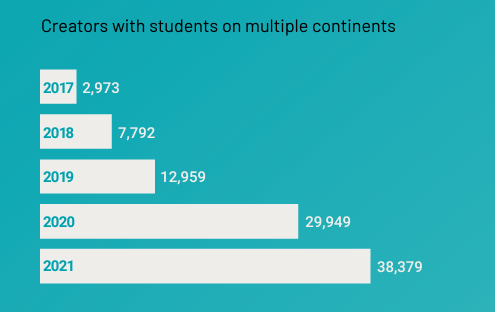
Source: Thinkific - 2022 Online Learning Trends
The number of course creators on the Thinkific platform with multinational students has steadily increased since 2017, experiencing a remarkable surge between 2020 and 2021. Undoubtedly, the catalyst for this growth is the impact of the Covid-19 pandemic on our working and learning environments.
The pandemic made us realize that innovation and improved ways of working and learning could be achieved by investing in technology and human capabilities. Online learning and technology-based collaboration tools allowed us to stay connected with the world while prioritizing safety indoors. Content localization, especially through multilingual translation using subtitles and dubbing, became indispensable for making videos accessible and engaging for everyone. Statistics indicate a consistent growth trajectory for the translation services market, projected to reach USD 46.22 Billion by 2028, with a CAGR of 2.07% from 2021 to 2028.
Not a Fad: Subtitles and Dubbing are the New Norm for Worldwide Reach
Breaking down language barriers is pivotal in making your content more learner-centric, accessible, and collaborative. If you are uncertain about where to start or which methods to use for localizing your courses, a helpful approach is to analyze the traffic to your site. Identify the locations from which your learners primarily come, and this will assist you in creating a list of languages to start globalizing into with subtitles and dubbing solutions. Additionally, consider looking into the fastest-growing languages on the internet as part of your strategy.

Content localization extends beyond the e-learning realm. Today's most successful streaming platforms, such as Netflix, Hulu, and Amazon Prime, have made substantial investments in subtitling and dubbing. By doing so, they've not only expanded their subscriber base globally but have also offered a personalized viewing experience in viewers' preferred languages. A noteworthy example is Netflix's evolution into the largest and fastest-growing OTT service in South Korea, boasting a 57.5% market share, showcasing the tangible impact of such localization efforts. Discover some surprising facts here.
For making more informed decisions and sound judgments, consider discussing your projects with a media localization company like Ollang. Our partners benefit from various services available at Olabs, our all-in-one-place platform. Olabs provides quality AI-powered subtitling, captioning, and dubbing solutions more accurately, with shorter delivery times and affordable prices. Collaborating with professionals passionate about creating more accessible media opens up new opportunities worldwide.