


Digitization has reshaped how we create, distribute and access content globally. MENA’s media and entertainment sector is not an exception, with the market, especially in the last couple of years, having marked a remarkable growth in overall viewership for audiovisual content. A fundamental shift in favor of digital media consumption took place during the national lockdowns due to the COVID-19 pandemic. Today, the MENA region offers a thriving space for video streaming providers, TV broadcasters, content creators, and localization professionals to function with success by delivering relatable content.
What kind of trends are dominating this ecosystem presently? How will this vibrant space evolve, and which tendencies are likely to dominate it for the rest of the year and well beyond? Keep reading to learn how to pivot your content and localization strategy for the Middle Eastern audience.
The topics covered in the rest of this article include:
① Viewers across the MENA region have several distinct features
② Video segments within overall media:
↠ OTT platforms
↠ Cinema
↠ TV
③ Multilingual content creation
④ Key media players that offer subtitles and dubbed content
⑤ Adaptation strategies for media companies looking to expand into MENA
Viewers across the MENA region have several distinct features
For the film, TV and OTT sectors, the term MENA represents all of the classic Arabic-speaking Middle Eastern countries (Bahrain, Egypt, Iraq, Jordan, Kuwait, Lebanon, Oman, Qatar, Saudi Arabia (namely, the Kingdom of Saudi Arabia, or simply KSA), Syria, the United Arab Emirates, which includes Dubai, and Yemen). It also includes the Arabic-speaking nations of Northern Africa (Algeria, Libya, Morocco, Sudan, and Tunisia) along with the Farsi-speaking nation of Iran. That’s why the Middle East is, in many cases, referred to as ‘Middle East & North Africa’, or simply MENA’.

↠ The Middle East is predominantly Muslim, and respect for religious sensitivities is vital. Although the increase in imported titles as well as younger generations have flexed the culturally conservative habits across the region, some issues such as overt sexuality, LGBTQ+, and offensive religious portrayals are still likely to be scrutinized by the media regulators.
↠ TV viewership is still the dominant form, with the free-to-air model leading the charge and pay TV following it in terms of viewer numbers and ad-revenue shares.
↠ The audience for OTT video is growing rapidly. Both regional and multinational video streaming platforms are gaining traction as a way for viewers to control their content preferences.
↠ Cinema is the leading medium in Saudi Arabia, and the government is heavily investing in this sector within its Vision 2030 initiative. Being home to a high number of expats, with Indians composing the majority, the audience desires to reach a mix of Hollywood, Bollywood, and locally-produced films and shows through different channels, both traditional and digital.
↠ The share of imported titles is increasing; thus, localization of global content is becoming more of a norm. Multinational content providers and media companies should not overlook the growing demand for localized content in languages such as Arabic and Persian through subtitling and dubbing.
Video segments within overall media
Considering the increased adoption of streamed media and high-growth drivers that impact the entertainment landscape of the region the region, we’ve categorized this segment as follows: "Video-on-Demand platforms" (OTT platforms, with a specific focus on SVODs); "Traditional TV" (including free-to-air and pay-tv models); and "cinema".
↠ OTT Platforms
Statista estimates that approximately 10.2 million subscribers accessed at least one over-the-top (OTT) and subscription-based video-on-demand (SVoD) services in the Middle East and North Africa (MENA) region in the fourth quarter of 2021. By 2027, the share of revenues gained from SVoD services is expected to account for a total of four billion U.S. dollars in the region.
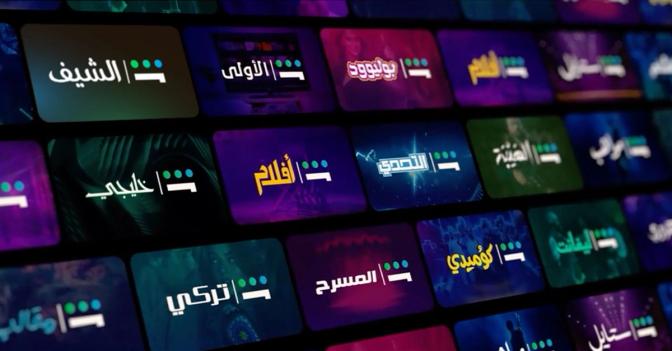
Netflix, StarzPlay Media, Amazon Prime, Disney+, and MCC Shahid are the key players dominating the video streaming space. Some others, including OSN Plus, Apple TV+, Eros Now, SonyLIV, BeIN Connect, and Iqiyi, deserve attention thanks to their initiatives to capitalize on the growth opportunities and meet audience expectations. YouTube leads the way as the biggest free video service in volume and value. In 2022, it generated two-thirds of all AVOD revenues in the Arab MENA.
↠ Cinema Traditional media such as linear TV and cinema are often reported to shrink in revenues and attract an increasingly smaller audience globally. However, the MENA region, especially Saudi Arabia, is a remarkable example that shows digitalization does not necessarily mean the death of theaters. PWC estimates that cinema will reach $1 billion by 2024 in Saudi Arabia, with a growth rate of 4% CAGR in comparison to a 2.4% decline worldwide between 2019 and 2024.
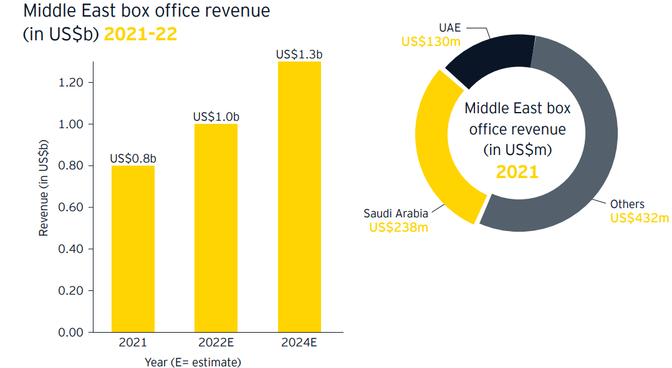
As can be inferred from the chart above, Middle East Box Office revenues steadily increase, reaching $1.3 billion by 2024, an estimation that is in line with PWC’s predictions. Across all MENA regions, Saudi Arabia stands out as a bright spot for investing. Several international film companies have already recognized the benefits of investing in the cinema sector and signed partnership deals with regional and local players. (You can see a detailed list of these partnerships in this report.)
↠ TV Broadcasting As is the case with cinema, the strong inclination to consume digital content in the region has not entirely replaced TV. It still appeals to mass audiences. In the case of Saudi Arabia, for instance, viewers spent an average of 5.1 hours per day watching TV in both 2021 and 2020, compared to 4.5 hours in 2019. Free-to-air (FTA) is mainly enabled by satellite TV technology and monetizes itself via TV advertising. Pay TV follows FTA in terms of the share of people watching it, with 20% on average. The considerable gap between the two models is primarily a result of piracy and the ease of access to FTA across the region.
Within this backdrop, we still cannot overlook changes in people’s tendency towards watching video through subscription-based and ad-supported streaming platforms. The graphic below shows that revenue gained from AVODs and SVODs registers a constant uptake between 2019 and 2023, while the share of revenues from pay TV decreases.
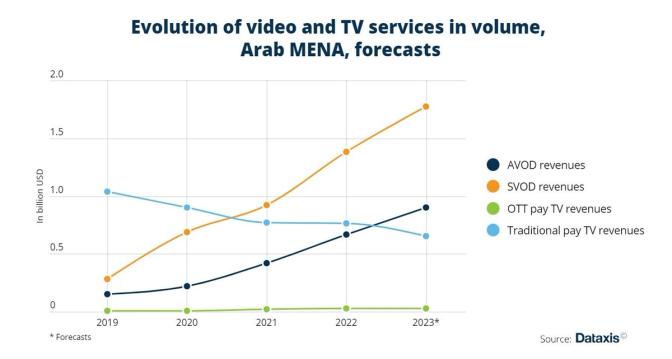
What do we see here? An opportunity for video streaming platforms and TV service providers to form joint partnerships. Such cooperation is essential for all media players to adapt their business models in a way that will widen their footprint and come up with a diverse range of offerings for viewers.
Multilingual content creation
Proliferation of digital content platforms, wide adoption of the internet, and ease of access to mobile devices. All have brought enormous popularity to video consumption, and this form will continue to be the future of how people engage with content. How has this change impacted the localization sector? Media localization companies are expected to come up with innovative and technology-led solutions that can meet expectations in terms of quality, accuracy, and affordability. Some genres are more popular than others in the MENA and they include series, Turkish and Hindi dramas, Korean shows, anime, and documentaries, as well as original programs that native people can identify with.
Video subtitling and dubbing into multiple languages are the most widely preferred ways of bringing foreign titles to global audiences. Now, it is possible through a strong cooperation between technology and the human’s creativity to meet the ever growing demand for engaging and relatable localized movies, series, and shows around the world.
Video Streaming Platforms That Offer Subtitles and Dubbed Content
Some video streaming platforms are revving up their efforts to subtitle and dub foreign content in different languages for the MENA viewers, with Arabic accounting for the dominant choice followed by Persian, French, and English (for non-English language titles). Statistics show that people in Saudi Arabia use Arabic three times more than English to do online research. Netflix and the likes have achieved important success by subtitling and dubbing the foreign content in their catalogs for Arabic-speaking viewers. Having seen how localized content taps into an otherwise unexplored audience, Netflix has also started producing original Arabian content and adapting it for countries speaking other languages than Arabic through subtitles and dubbing.

Iqiyi and MBC Shadid are among the few video streaming platforms that offer foreign content for audiences in the MENA region. The focus of the former is on Chinese and Korean content, and it imports primarily K-dramas, movies, and anime. Offerings come with subtitles in 10 languages, including Arabic. Shahid, owned by MBC, deserves attention as one of the platforms that has an extensive library of series, documentaries, and movies not only in Arabic but also with English and Turkish subtitles and dubbing. Last but not least, players within the cinema sector are developing strategies to increase the number of titles exported to other countries. In this respect, it’s important to define the right target markets that predominantly Arabic content appeals to. In the opposite direction, the key to making imported international content function successfully is to adapt it where required, considering the social and cultural sensitivities.
Adaptation strategies for media companies looking to expand into MENA
Industry players can benefit from the strategies below to set goals for the near future and beyond:
○ Offering subscription-based plans combined with ad-supported tiers at different prices
○ Experimenting with various content distribution channels (for example, news channels can repurpose their suitable content into podcasts, stream them on digital media, and consider widening their outreach to international audiences with multilingual content creation)
○ Producing original programs that are in tune with the cultural interests and sensibilities
○ Maximizing the value of existing foreign content by subtitling and dubbing it into Arabic and other languages spoken in the region
○ Encouraging regional and international media companies to establish joint partnerships
○ Collaborating with governments and regulation makers to support the development of digital production and distribution infrastructure
○ Applying tax reductions and other initiatives to incur the interest of regional and international investors.
Final Remarks
With a highly vibrant and thriving environment, the entertainment industry in MENA is lucrative for both regional and international media companies. They can scale up their businesses, explore new audiences, and establish a solid existence by personalizing the viewing experience through localized content across MENA regions. On the other side of the spectrum, it is possible to maintain the momentum that the MENA region has gained by bringing locally produced content to international audiences. We can diversify the content that people around the world can access - with captivating re-storytelling in multiple languages. This is the essence of the business we do at Ollang.
Time-bounded restrictions and high production costs don’t need to be the primary concerns for the companies and should not keep them from starting localization projects. With the involvement of human translators and editors, AI-powered subtitling and dubbing solutions accelerate the otherwise quite long and challenging localization processes and yield high quality outcomes at affordable prices and quicker delivery times.
With Olabs showcasing its capabilities, you can confidently embark on your journey to explore new audiences, overcoming time constraints and high production costs in the process.