


Since video content is increasingly reaching global audiences, let's explore some important terms related to subtitling and dubbing videos for different languages and cultures. With this knowledge, as a content owner, you will be able to accurately assess your specific localization needs and evaluate capabilities of Language Service Providers (LSPs) you might choose to work with.
You will not encounter a long list of terms filled with industry jargon and technical language. Instead, we will explain the most relevant terms in a clear and concise manner. Whenever possible, we'll use examples and case studies to illustrate the practical impact of each term.
➊ Closed Captions (CC):
Closed Captions (CC) are on-screen text overlays that display the spoken dialogue and relevant sounds of audiovisual content, such as news reporting. They enable viewers to read along with the news stories, making them accessible to individuals with hearing impairments or those in noisy environments where audio cannot be heard.
Use Case:
A major news network broadcasts a breaking news report on a significant global event. To ensure that the crucial information reaches all viewers, the network provides Closed Captions (CC) alongside the news segment. This allows individuals who are deaf or hard of hearing to stay informed about the unfolding situation, fostering a more inclusive and informed society.
➋ Multilingual Subtitles:
Multilingual subtitles are text-based translations of the spoken dialogue in audiovisual content, displayed on-screen in multiple languages. They enable viewers who don't understand the original language to follow along with the content and fully engage with the storyline or information being conveyed.
Use Case:
Within a multinational company, the marketing team creates localized videos for internal use, such as training sessions, employee dialogues, and market research presentations. To ensure effective communication across their diverse workforce, the marketing team includes multilingual subtitles in these videos.
➌ Voice Over:
Voice over is an audio recording technique where a professional voice artist or AI-generated voice narrates and provides the spoken content for an audiovisual piece. (Refer to this article to understand the difference between voice over and lip-sync dubbing.)
Use Case:
An educator uses AI-generated voice-over technology to provide online course content in English efficiently and cost-effectively. By utilizing AI for voice over, educational content creators can scale their content localization efforts and offer personalized learning experiences tailored to individual preferences.
➍ Studio Dubbing
Studio dubbing is the process of replacing the original audio track with a synchronized translated version in a different language. Skilled voice actors perform the dubbed dialogue in a recording studio, ensuring lip-sync and preserving the essence of the characters' emotions and voices.
Use Case:
In this case, a movie production company opts for studio dubbing services for its Turkish movies to make them reachable for a broader viewership in Pakistan and other Urdu-speaking regions. Talented Urdu voice actors meticulously dub the Turkish dialogue, matching lip movements, and emotions to provide an authentic and immersive experience for Urdu-speaking audiences.
➎ AI Dubbing and Hybrid Dubbing
In AI dubbing, artificial intelligence algorithms are used to replace the original audio track of an audio visual content with a translated version in a different language. The AI system analyzes the source audio and performs speech synthesis to generate the dubbed dialogue without human intervention.
Hybrid Dubbing is, on the other hand, a dubbing process that combines the capabilities of artificial intelligence with human expertise. In this cutting-edge and dynamic approach, sophisticated artificial intelligence systems carefully analyze the audiovisual content to identify sections that require dubbing. This process strategically allocates the more sophisticated and complex parts of the dubbing to these human professionals. Meanwhile, the simpler and repetitive tasks are efficiently handled by artificial intelligence, capitalizing on its speed and precision advantages.
Use cases:
AI Dubbing
Voice cloning is one of the application areas that uses AI-enabled speech recognition and synthesis technologies to clone the voice of a person. In our case, a Turkish content creator employs Ollang's AI dubbing to clone her Turkish voice into English. This allows her to produce English-dubbed versions of her recipe videos, reaching a broader international audience and attracting English-speaking food enthusiasts worldwide.
Hybrid Dubbing
In this scenario, we have a well-known content creator whose English content undergoes a comprehensive hybrid dubbing process. First, an AI-based speech recognition system transcribes her English videos into text. Next, AI-powered subtitling technology automatically translates the English text into Spanish and Italian subtitles. Finally, the subtitled content is carefully dubbed using hybrid dubbing, where professional voice actors fine-tune the AI-generated voices to ensure cultural accuracy and emotional resonance.
Examples in various areas:
Credits: Alex from the Rock/Shutterstock
Other typical examples that can benefit from the specified localization methods include:
- Foreign language documentaries and TV series
- Webinars and language exchange programs
- Interactive language learning apps
- Podcasts for international audiences
- Corporate Training Videos for Multinational Employees
- Audiobooks and Presentations
- Video Games with Character Voices
- Reality Shows
- Marketing videos and advertisements
- Government Announcements
In addition to these widely used localization methods, it is advantageous to become acquainted with the following terms:
➏ Quality Assurance:
Quality assurance involves meticulous review, testing, and verification of the translated material to guarantee accuracy, cultural appropriateness, and adherence to project requirements and industry standards.
At Ollang, our focus on attention to detail is especially evident in projects involving niche subject areas and challenging language pairs, like English to Arabic, where we assign our top translators for post-editing processes. Human involvement plays a vital role in quality assurance, as our experts review AI-generated translations or adaptations to guarantee accuracy, clarity, and cultural appropriateness.
Use Case:
In our scenario, a renowned TV broadcaster aims to release a romantic TV series globally. First aired on their TV channel, they now adapt it into shorter episodes for YouTube. They use AI subtitling technology for initial subtitles in +12 languages and employ human editors and translators to ensure precise synchronization, cultural relevance, and a captivating viewing experience for international audiences.
➐ Language Variance and Voice Diversity
Language variance encompasses the regional differences and variations that occur within a language. On the other hand, voice diversity refers to the range of voices that offer diverse options, such as different ages, genders, dialects, and accents, enabling more inclusive and engaging content experiences.
Use Case:
In an animated cartoon set in South Korea, the voices of two kid players are seamlessly dubbed using AI-generated synthetic voices. This includes authentic child voices reflecting their age and the Gyeongsang dialect specific to a region in South Korea.
➑ Localization Platform
A localization platform enables efficient management of localization projects by providing various dashboards for different users, facilitating order creation, tracking projects, enabling collaboration among teams, and offering customer support.
Use Case:
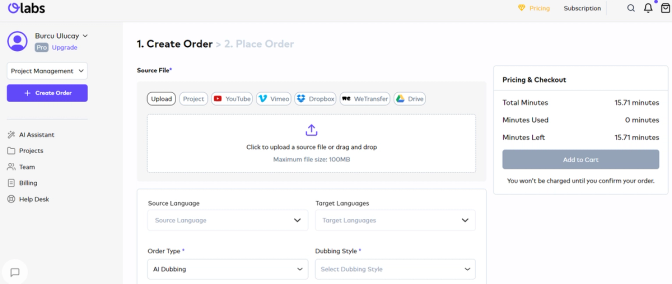
OLabs, an AI-driven content localization platform by Ollang, serves as the ultimate platform for all content localization needs. With separate dashboards for translators, clients, and vendors, OLabs caters to diverse user requirements seamlessly. Some of the outstanding features incorporated into the platform include project management, translator manager, subtitling studio and AI dub studio.
Clients can choose from a range of localization services at OLabs, including closed captions (CC), subtitling, AI dubbing, and hybrid (studio) dubbing. Options for human translator review and checks further enhance the quality and accuracy of localized content.
Embracing the Power of Hybrid Approach
Starting your first localization project or pivoting your strategy to yield more tangible results may be daunting on your own. Gaining familiarity with the essential terms explained above lays a strong foundation for making informed decisions and selecting a reliable localization partner you can trust.
At Ollang, we offer cutting-edge technology and a team of skilled linguists to bridge language barriers and connect businesses and content creators with global audiences. A hybrid approach, blending the capabilities of AI with the invaluable insights of human translators and localization experts, emerges as the optimal strategy in the video localization landscape. Our AI-powered platform, OLabs, unleashes the power of global reach, ensuring your stories are heard and understood across borders.
Together, we can create a more inclusive and culturally aware media landscape, where your content resonates with audiences around the world.