
Content owners and distributors face persistent challenges with video translation despite significant investment.
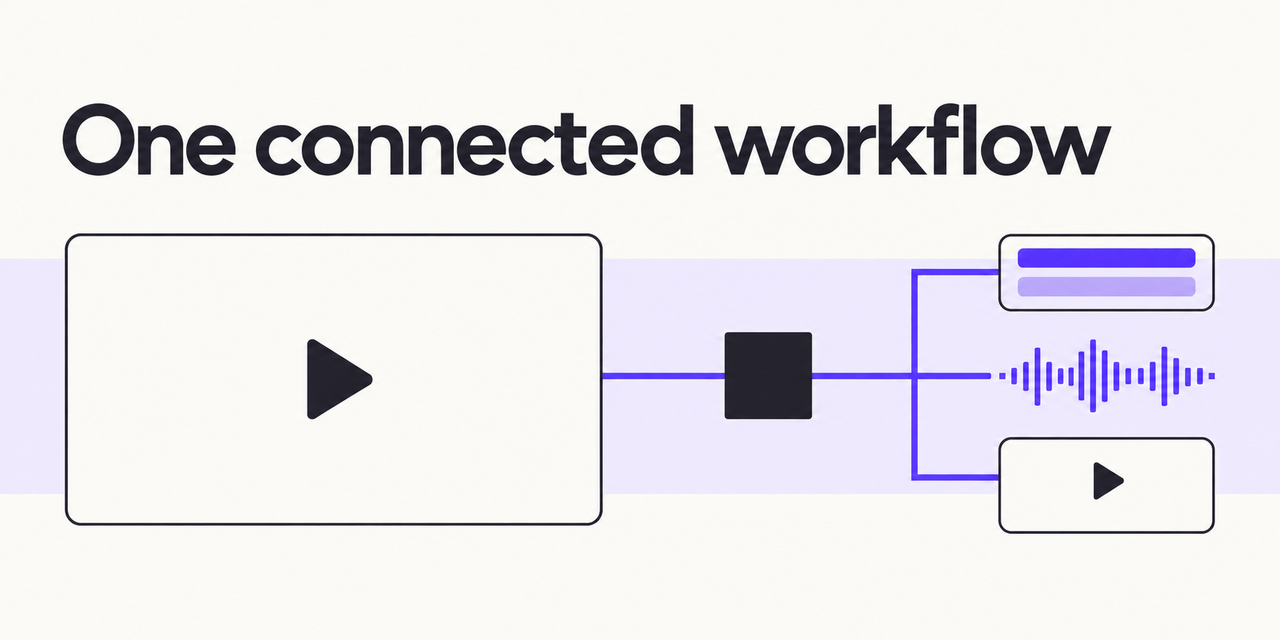
They struggle with scattered workflows that require multiple tools and collaborators, which often leads to delays and complicates oversight. Translations often fail to reflect cultural and local nuances, as manual processes miss critical errors. Rapid market changes also force them to update translations quickly, yet accuracy frequently suffers.
Ollang addresses these challenges through Multiagent AI. Our system, composed of specialized AI agents for distinct tasks, delivers an adaptive workflow for localization and quality assurance.
Challenges of Video Translation
Subtitling, dubbing, and cultural adaptation form the core of video translation, and each presents specific obstacles.
Subtitles must sync precisely with dialogue and follow strict formatting standards for reading speed and line breaks.
Dubbing requires natural tone and lip-sync accuracy to maintain an immersive experience.
Cultural nuances pose perhaps the greatest challenge, as idioms, humor, and references need thoughtful adaptation to resonate with local audiences without losing original intent.
Traditional automated tools struggle because they lack a modular, multiagentic structure. Our early evaluations of the M3 Framework (Multilingual Multimodal Multiagentic) showed a 60%+ reduction in translation errors by using specialized AI agents for each aspect of the translation process.
Drawbacks of the Traditional Translation Methods: Time, Cost, and Quality
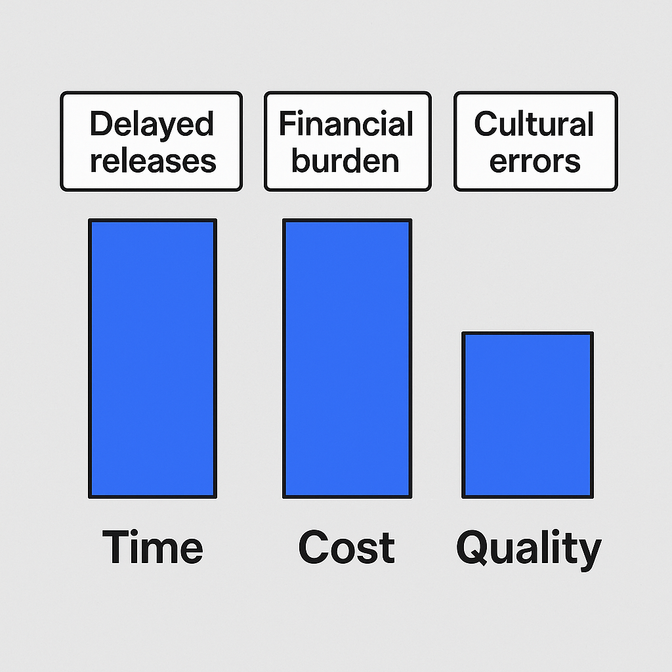
Traditional translation methods, whether human-dependent, neural machine translation (NMT), or single large language models (LLMs), struggle with issues of time, cost, and quality.
Time Delays
Human-centric workflows require days to localize a 60-min episode. This forces content owners, such as streaming platforms, to delay global releases and miss key market opportunities.
High Costs
Heavy dependence on translators and manual editing restricts global reach for industries like manufacturing and elearning.
Quality Gaps
Traditional systems struggle with idiomatic expressions, cultural nuances, and dialects. The accuracy decreases as content requires context-specific adaptations, leading to translations that feel unnatural or irrelevant to target audiences.
Multiagent AI is the Right Solution for Video Translation - Here’s Why
By assigning dedicated agents to distinct translation aspects, this approach mirrors the collaborative workflows of human specialists. It uses generative AI, feedback loops, and multimodal integration to deliver superior results.
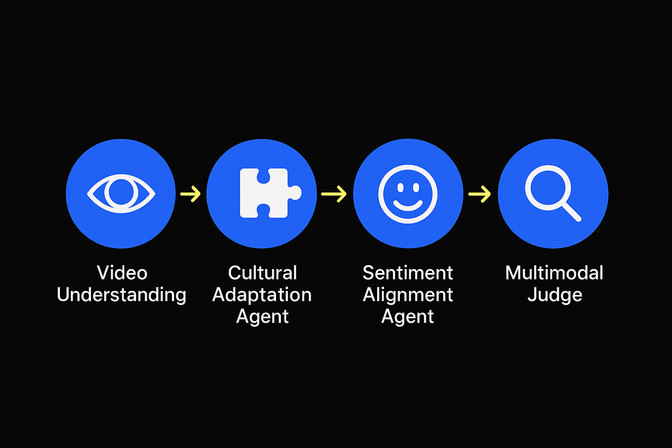
Key AI Agents in Ollang's Multiagent Translation Framework
① Video Understanding Agent: Analyzes source material through scene analysis and speech transcription. This agent detects visual and audio context that single-model approaches miss.
② Cultural Adaptation Agent: Aligns content with target audience norms through cultural databases and knowledge bases to prevent misunderstandings.
③ Sentiment Alignment Agent: Maintains emotional tone across languages to keep the mood and impact intact.
④ Multimodal Judge Agent: Evaluates output fidelity against source content across all modalities and serves as quality control before delivery.
By processing text, audio, and video simultaneously, this system maintains coherence across all content elements, essential for media localization where format matters as much as words.
Proven Results from Performance Benchmarks
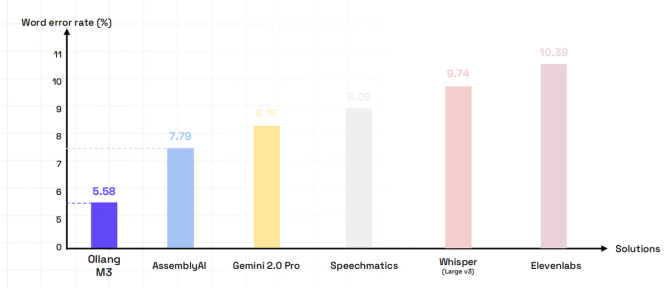
‣ Speech-to-Text: Ollang’s Multiagent AI achieves a 5.58% word error rate (WER) for animation content, outperforming AssemblyAI at 7.79% and Gemini 2.0 Pro at 8.18%. A lower WER reflects higher accuracy.
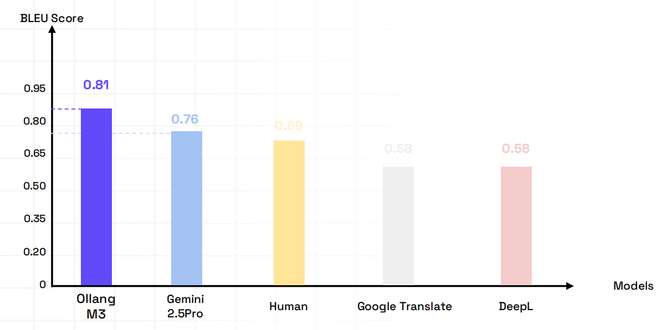
‣ Translation Quality: A BLEU score of 0.81 for technical documents surpasses Gemini 2.5 Pro (0.76) and Google Translate (0.58).
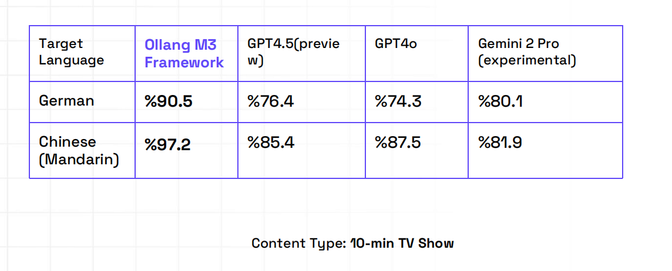
‣ Subtitle Localization: Delivers 90.5% accuracy for German and 97.2% for Mandarin Chinese, compared to GPT-4.5's 76.4% and 85.4%, respectively.
These metrics translate to more accurate captions and higher-quality translations with significantly less manual editing required.
Businesses can now distribute content globally, with lower costs and faster turnaround times, while maintaining higher quality standards across languages.
Case Study: Ollang's Impact on Streaming Platforms
A content distribution platform faced the challenge of localizing over 10,000 short videos. Traditional approaches couldn't scale to meet demand while maintaining quality standards.
After implementing Ollang's multiagent AI, the platform achieved:
➼ 83.3% cost reduction per minute of content
➼ An estimated 76% time-saving across multiple languages.
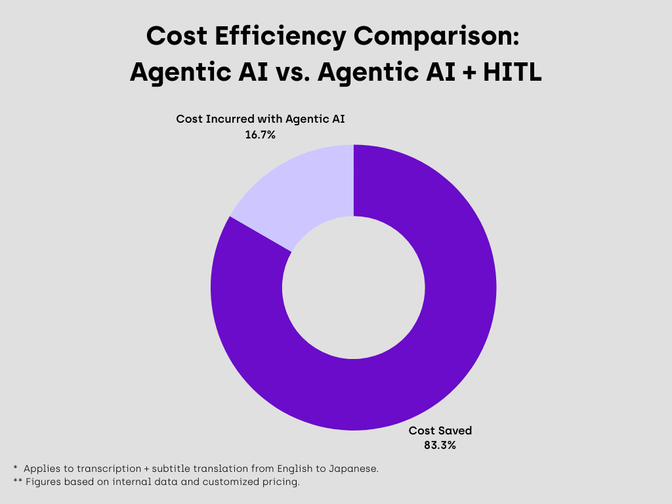
They now serve global audiences with consistent brand voice in 11 languages while meeting tight release schedules.
Meeting Accessibility Requirements with AI Video Translation
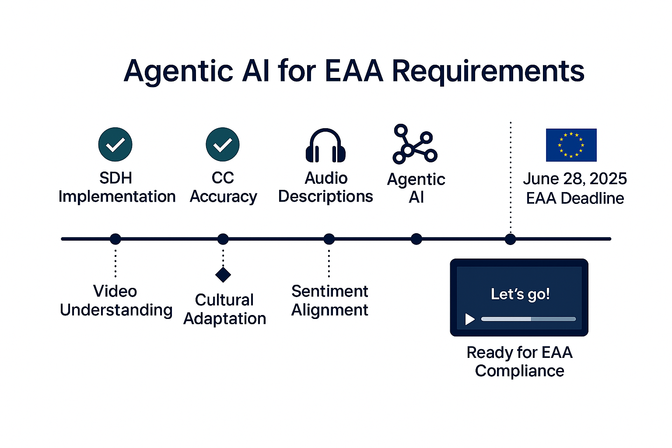
Regulations such as the European Accessibility Act (EAA) in the EU or ADA in North America require digital products and services to be accessible to people with disabilities.
The sheer volume of content makes manual creation of compliant subtitles practically impossible for organizations, creating a significant operational challenge.
Ollang's Multiagent AI addresses these challenges by delivering:
① Compliant subtitles and captions with high accuracy.
② Proper timing and synchronization essential for accessibility.
③ Cultural context preservation that enhances understanding.
④ Consistent quality across massive content libraries.
How to Create to Compliant Captions with Ollang
Localization buyers can subtitle videos from start to finish, including editing, within our localization platform OLabs.
Steps to Create Accessible Captions and SDH
① Place Caption Order: On the order page, select the video captioning option, and choose the folder and project. Users can also upload videos via YouTube, Vimeo, or Dropbox links.
② Select Caption Type: Opt for closed captioning to meet regulatory compliance with descriptive elements.
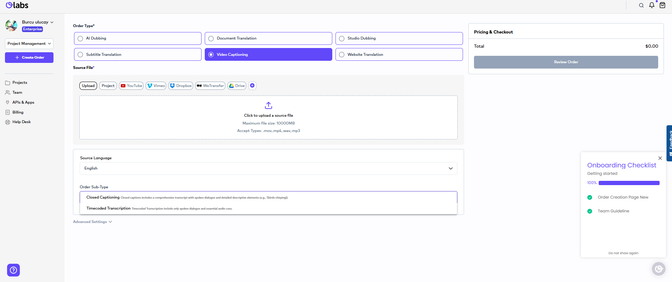
③ Review and Submit Order: Verify order details and submit. Ollang's agentic AI generates captions and SDH automatically, with an option for human editing to enhance quality if needed.
④ Access and Edit Outputs: OLabs completes the order. Users review subtitled versions, make edits directly in the platform, or download the video with SRT files in various formats.
AI Dubbing Solutions
While subtitling provides an accessible and cost-effective solution for global reach, dubbing creates a deeper audience engagement. However, traditional dubbing processes are prohibitively expensive for many businesses.
Recent advancements in speech synthesis have turned this costly process into a reachable service for productions at various investment levels.
Content owners can start with subtitles to test market traction, then add AI dubbing as ROI and viewership grow, to cut both cost and time compared to traditional studio dubbing. This approach works especially well for marketing clips, documentaries, short series, and training videos.
Multiagent AI as the Foundation for Dubbing
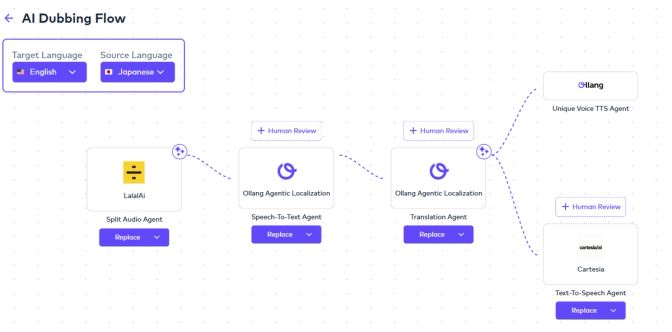
Our system first generates high-accuracy translations for captions and subtitles by capturing context, tone, and cultural nuance.
Those subtitle translations become the script for dub.
With a precise script in hand, our partners select voices from a library of synthetic, cloned (with consent), or unique AI voices.
Once AI generates the first pass, AI editors refine:
‣ Lip-sync alignment and overlap handling
‣ Volume leveling and timing adjustments
‣ Minor translation tweaks to match mouth movements.
Case Study Spotlight: 600+ Hours Dubbed
A French digital content distributor began AI dubbing two years ago — so far they've localized over 600 hours of content. Their sustained commitment speaks to both the quality and audience satisfaction Ollang delivers.
Next Steps: Implementing Multiagent AI in Your Content Strategy
Specialized AI agents work together to truly understand content, keep cultural context intact, maintain emotional tone, and create outputs that sound natural to local audiences. This solves the old problem of having to choose between speed, cost, and quality for global expansion through closed captions and multilingual subtitling and dubbing.
For content owners, this enables simultaneous global releases, consistent brand voice across languages, and accessibility compliance without increasing budgets — essential capabilities as regulations tighten and audience expectations rise.
Try Multiagent AI translation yourself to see the results firsthand: https://ollang.com/get-a-demo
For enterprise volume content, fill out the form to contact our partnerships team.