

Forget about keywords, backlinks, and headings for now. We all know those are crucial for SEO and reaching a wider audience. But today, we’ll focus specifically on video SEO. You might think "video SEO" sounds broad – and you'd be right. But here's a specific question:
Can adding subtitles and dubbing improve your videos' SEO and online visibility?
Yes, it can. (I wouldn't ask if the answer was no, right?) The next question is: how can you use subtitles to boost SEO, and what's the simplest way to do it? If you're curious about the answer (and we hope you are, or you'd stop reading), the rest of this post will give you what you need.
How Video Localization Enhances Your Video SEO
While dubbing your video into target languages is a great way to break free from a single-language audience, SEO requires more.
Search engines like Google can't grasp spoken content. They rely on text to index and rank videos. This means both visuals and voiceovers are invisible to search engines unless you provide textual assistance.
Add subtitles, captions, and translated descriptions (metadata) in different languages to your videos. This allows search engines to understand your content and connect your videos with viewers actively searching for what you offer. Through video localization, you can climb the search engine rankings and gain greater visibility in your target markets.
However, localization benefits beyond visibility. Here are some additional SEO advantages of video localization:
➔ Increased Traffic: Localized videos appear in search results for viewers in different languages, driving more traffic to your website.
➔ Reduced Competition: Targeting niche audiences in other languages not only expands your reach, but also positions you as a global figure in your field.
➔ Stronger Engagement: By providing subtitle translations and closed captions, you cater to a wider audience, including deaf and hard-of-hearing viewers. Increased watch times, comments, and subscriber growth all contribute to positive SEO signals, further boosting your ranking.
Dubbed Videos & SEO: Why Captions Are Key
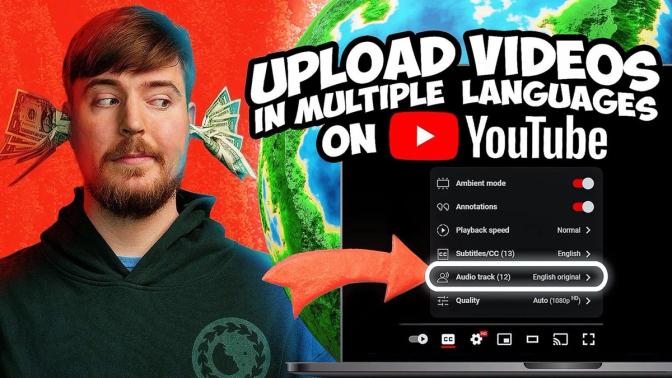
The rise of AI dubbing is making video localization more accessible for content owners. But to truly unlock the full potential of your dubbed videos, you need to make them visible to search engines.
This is where transcripts, closed captions, and translated metadata (descriptions and titles) become crucial. These elements act as a bridge, allowing search engines to grasp what your video is about and who it's for.
What do you gain by adding captions to your videos?
➔ Improved Indexing: Captions provide search engines with the text equivalent of your video's content. This allows them to understand it better and potentially rank it higher in relevant searches.
➔ Multilingual Optimization: Translate your captions to reach global audiences. This opens doors to targeting keywords in different languages, expanding your SEO reach and visibility.
➔ Enhanced User Experience: Captions benefit viewers who are deaf or hard of hearing, or who prefer watching videos with sound off. This broader accessibility can improve viewer engagement, a factor that can positively impact your SEO.
➔ Featured Snippets and SERP Features: Google sometimes displays video snippets with captions in featured snippets or SERP video carousels. Optimized captions can increase your chances of appearing in these coveted spots.
Simplifying Localization with a Single, Robust Platform
Managing transcription, translation, dubbing, and captioning can feel overwhelming. Consider partnering with an audiovisual localization company that offers end-to-end solutions. These companies can handle the entire process, ensuring your videos are optimized for both global audiences and search engines. Look for companies that:
1. Embrace AI Integration: They should leverage AI tools for efficient workflows while maintaining human expertise for quality control and refinement.
2. Offer Robust Platforms: Platforms like OLabs allow you to manage your projects conveniently, either by subscribing for self-service localization using AI tools or by assigning projects for full-service completion.
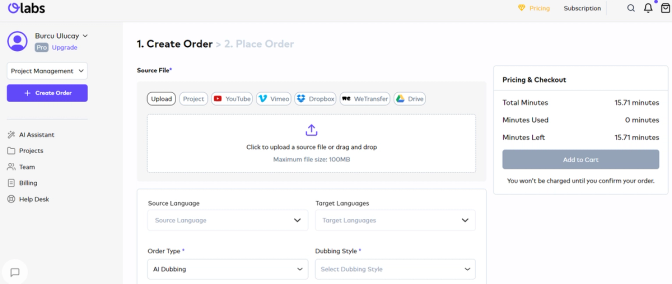
At Ollang, we understand that every content owner has unique needs and goals. Budget, resources, and deadlines all play a role in finding the perfect localization solution. That's why we built an ecosystem centered around OLabs.
Do you have a trusted team of translators, voice actors, and editors you prefer to work with? OLabs provides the perfect collaboration hub. Manage projects easily, track progress in real-time, and communicate seamlessly with your team – all within the platform.
We offer various subscription plans to fit your budget. With these plans, you gain access to powerful tools like the AI Dub Studio, Subtitle Studio, and Translator Manager.
And for those who want a complete solution, Ollang offers end-to-end services. We handle everything, from AI-powered subtitle translation and closed caption generation to AI dubbing. Whether you choose pure AI or a hybrid approach that combines AI with human expertise, Ollang helps you connect with a global audience.
By partnering with the right localization company, you can ensure your videos are heard by the right audience and achieve SEO success.
AI and Video Localization: A Powerful Partnership
Traditionally, getting your video dubbed meant working with human translators, voice artists and dubbing studios. This approach delivers high-quality results but comes with limitations:
➔ Cost: Professional translation and dubbing can be expensive, especially for multiple languages. This can be a barrier for many content owners.
➔ Time: The traditional process can be time-consuming, with back-and-forth communication and studio bookings delaying the release of localized content.
AI-powered localization tools have certain benefits over traditional methods:
➔ Affordability: AI translation is significantly cheaper than traditional methods. AI can analyze vast amounts of data, reducing the need for human intervention, and lowering overall costs.
➔ Speed: AI can translate text and generate subtitles much faster than human translators. This allows you to reach new audiences quicker and capitalize on trending topics before the hype fades.
➔ Scalability: AI tools can localize large volumes of text into multiple languages efficiently, making it easier to reach a truly global audience.
AI is not replacing human translators and voice artists. Instead, we're witnessing a transformation towards a hybrid approach. AI tools streamline repetitive tasks, while human expertise ensures quality control, cultural nuances, and natural-sounding dubs. Building an environment where technology and human talent coexist allows for the most responsible and beneficial localization solutions.
The rise of AI dubbing coincides with the popularity of video content creation. After all, with Semrush reporting video as the best performing content format in their annual report, how can creators and brands ignore its power?
They can't. As a content owner, you can't afford to ignore the power of video. But you can afford to translate your videos into as many languages as you wish with OLabs.
Our single, robust platform, featuring strong APIs, project management tools, and AI translation with Human-in-the-Loop (HITL) support, is here to work alongside you.