
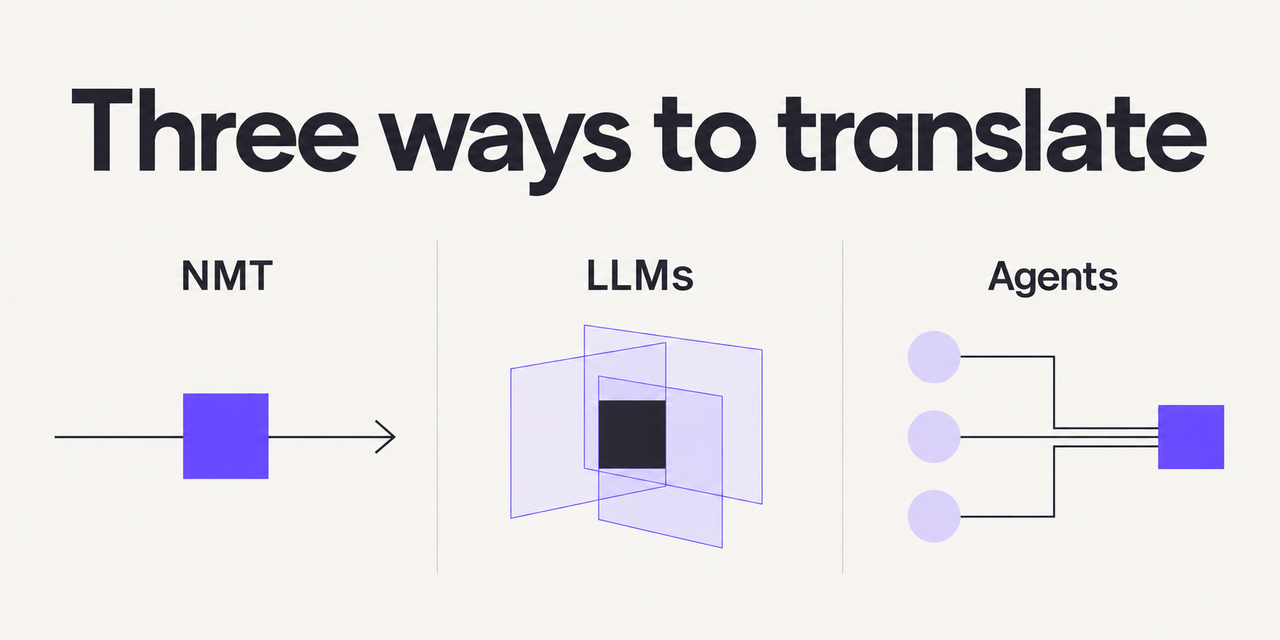
Companies expanding globally face a translation dilemma. Manual translation takes too long and costs too much for the volume of content they need to localize. They know they need AI translation for efficiency and scale, but the wrong choice creates more problems than it solves. Some technologies work well for speed but produce poor results with specialized content. Others handle nuance well but collapse under volume pressure.
Neural Machine Translation (NMT) made the first leap forward, Large Language Models (LLMs) added broader fluency, and now Agentic AI tackles the problems that break other systems. This comparison shows you exactly when each technology works and when it fails.
NMT translation technology: benefits and limitations
Neural Machine Translation uses neural networks to predict word sequences. Unlike older methods that translated words individually, NMT processes complete sentences, which creates more natural output.
NMT works well with general content and common language pairs. It produces grammatically sound translations and handles basic sentence structures well. A customer service email or product description usually comes out readable and functional.
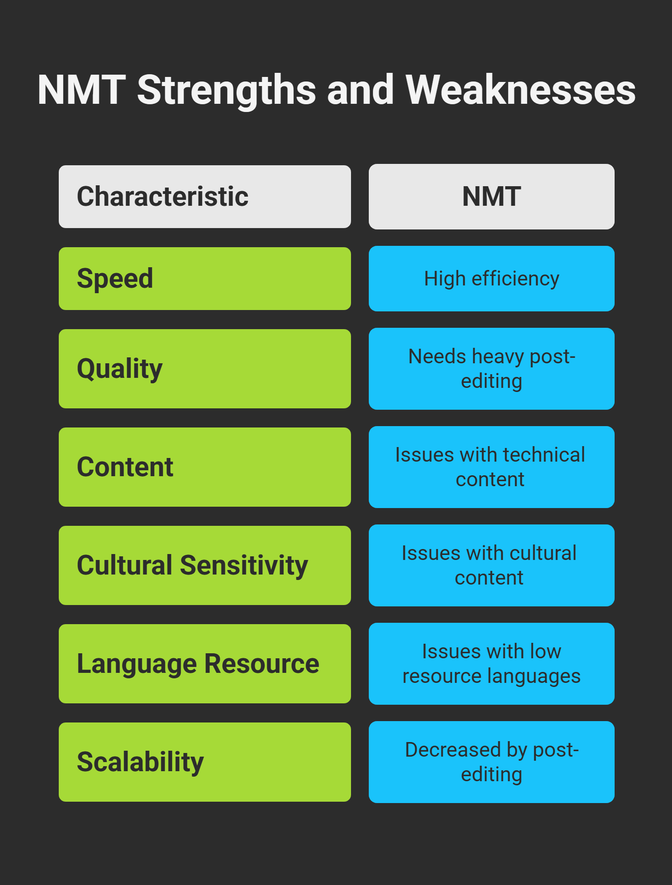
Its performance drops with subtleties, specialized terminology, and rare language combinations. Translation quality varies based on available training data for each language pair and subject matter. While NMT processes high volumes quickly, it requires human post-editing for professional quality, especially with technical or culturally nuanced material.
The real cost of NMT isn't the per-word price, it's the editing time afterward. Teams often spend more hours fixing NMT output than they would have spent on manual translation, especially for content that requires cultural adaptation or domain expertise.
Translation with LLMs: context beyond words
Large Language Models expanded translation capabilities starting in 2021 through their extensive language exposure. Trained on diverse datasets, LLMs understand context, style, and cultural elements better than NMT. They grasp meaning beyond literal words, which results in more fluent translations.
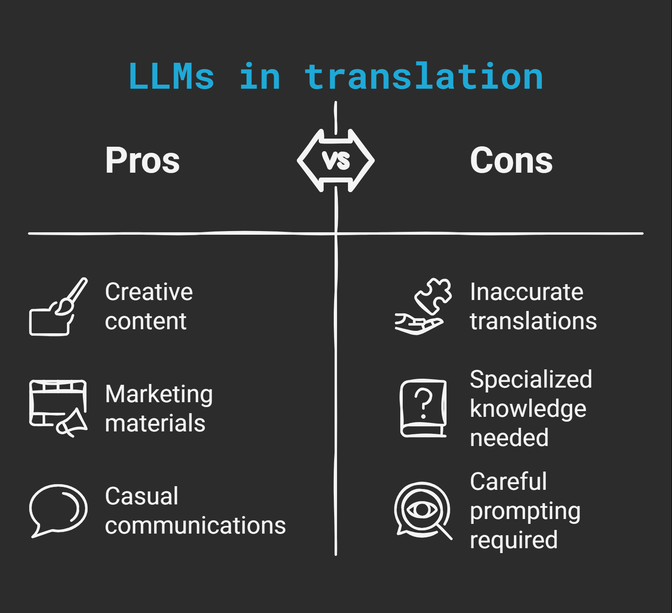
They show clear advantages in creative content, marketing materials, and casual communications. They adapt tone to match target audiences and handle unusual expressions better than NMT.
However, testing reveals that general-purpose LLMs perform poorly in audiovisual translation. For example, when translating animated series for international markets, even advanced LLMs like GPT-4 struggle with cultural references, contextual consistency, proper names, formatting for subtitles, and timing without careful prompting or additional training.
How Agentic AI solves complex translation challenges
Agentic AI builds on LLMs, but unlike standalone models specialized agents divide challenging translations into discrete tasks. These agents work together using specific tools, knowledge bases, and feedback loops to achieve accurate results with minimal human input.
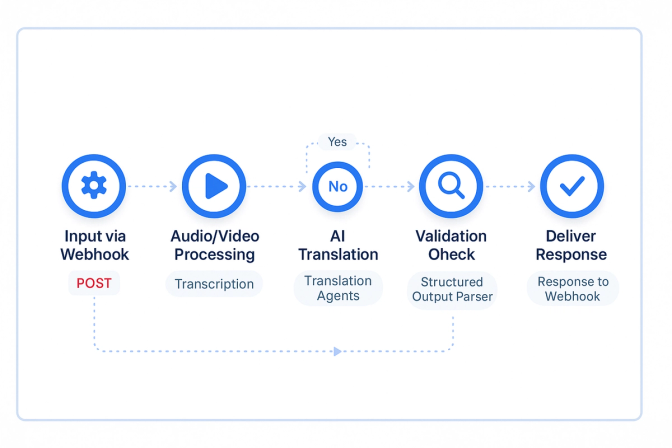
Our M3 Framework (Multilingual Multimodal & Multiagent) shows this difference in practical examples.
When translating idiomatic expressions like "heads on a swivel," the system applies culturally appropriate German expressions rather than literal translations. For professional titles like "Secretary Durant," it correctly identifies "Ministerin Durant" (cabinet minister) while GPT-4o produces "Sekretärin Durant" (basic secretary). When localizing animated series and TV shows, Ollang achieves 90.5% subtitle accuracy for German, significantly outperforming GPT-4.5 (76.4%) and other leading models. This accuracy measurement considers proper cultural adaptation, subtitle segmentation, and formatting, critical elements for media content.
Comparing AI translation systems for scalability and accuracy
Each technology offers different trade-offs for accuracy and scale.
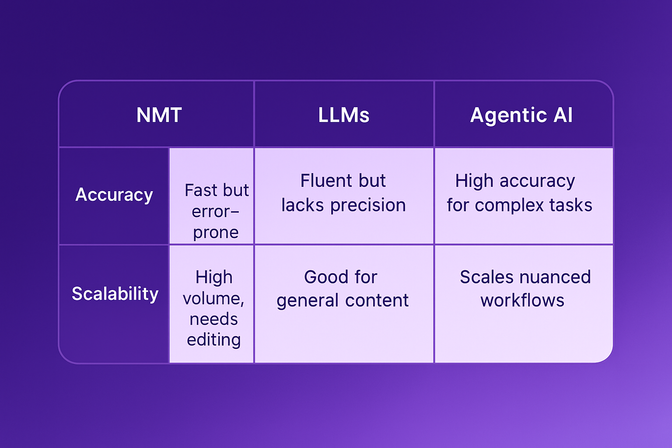
NMT handles volume well but sacrifices accuracy without human editing. You get speed but pay for it in post-editing time.
LLMs improve fluency but lack precision in specialized areas. They're better for general content but unreliable for technical or culturally sensitive material.
Agentic AI automates nuanced tasks through specialized agents and delivers higher accuracy than the other two methods. It particularly works well in challenging content like animated series or technical documents.
The combination of accuracy and automation makes agentic AI the optimal choice for enterprises that need reliable, scalable localization across diverse content types.
Choose the right AI translation approach
The right choice depends on your specific content needs:
For basic internal communications: NMT may be sufficient if you can tolerate some editing overhead.
For general content: Standard LLMs offer improved fluency for audience-facing materials where tone matters.
For media localization, technical documentation, e-learning or niche content: Agentic AI systems provide the precision and scale required when accuracy and cultural adaptation are critical.
Next steps for better translation results
➊ Evaluate your current translation quality: Does your content create the desired impact on the target audience?
➋ Identify your most challenging content types: Are you struggling with technical documentation, creative marketing, or multimedia localization?
➌ Consider your workflow efficiency: How much human post-editing do your current translations require?
We show in our posts how media companies, e-learning platforms, and global businesses broaden their global reach and meet accessibility requirements with Ollang's M3 Framework.
Contact our team to discuss your specific localization challenges and learn whether an agentic approach fits your needs.