


With advancements in AI technologies, content owners and localization professionals face a critical question:
We can localize more content with AI. But should we?
The answer is clear: Yes. With the right approach. Two factors are paramount to achieving optimal results:
➢ Using multiagentic AI localization systems that provide flexibility and precision for diverse projects like subtitle translation.
➢ Selecting the right AI voice type, for dubbing, based on the audio requirements. For instance, our partners can choose between pre-trained voices, unique voice agents, or cloned voices (with consent).
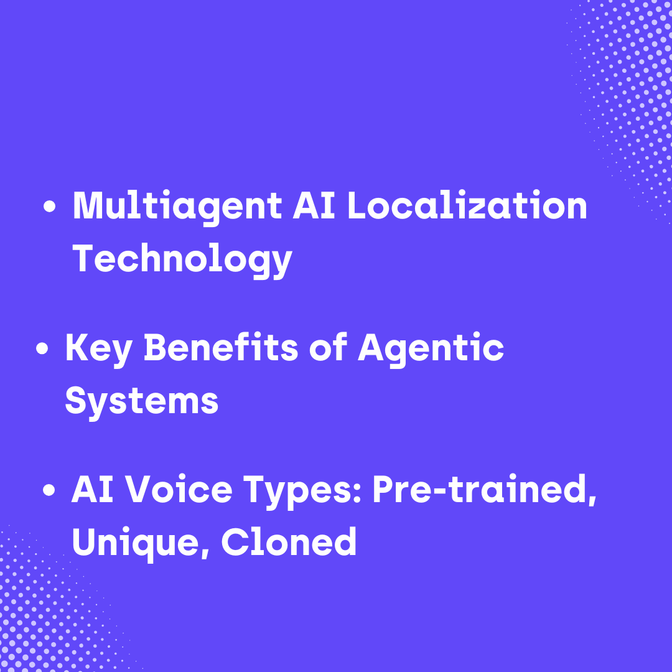
In the sections that follow, we will first explore the technological components driving multiagentic localization and the key benefits they offer to content owners seeking to expand their audience.
We will then explore the different AI voice types available at Ollang to provide insights into how each can enhance your localization projects.
① The Technology Behind Agentic AI Localization
✔️Automatic Speech Recognition (ASR):
ASR plays a critical role in localization by transcribing audio and capturing the emotional nuances of speech. In Ollang's agentic workflow, our Video Understanding Agent leverages advanced computer vision and speech-to-text technologies to handle scene segmentation, object detection, and transcription. The result is a more precise localization which preserves the emotional tone of the original content across languages.
✔️Large Language Models (LLMs):
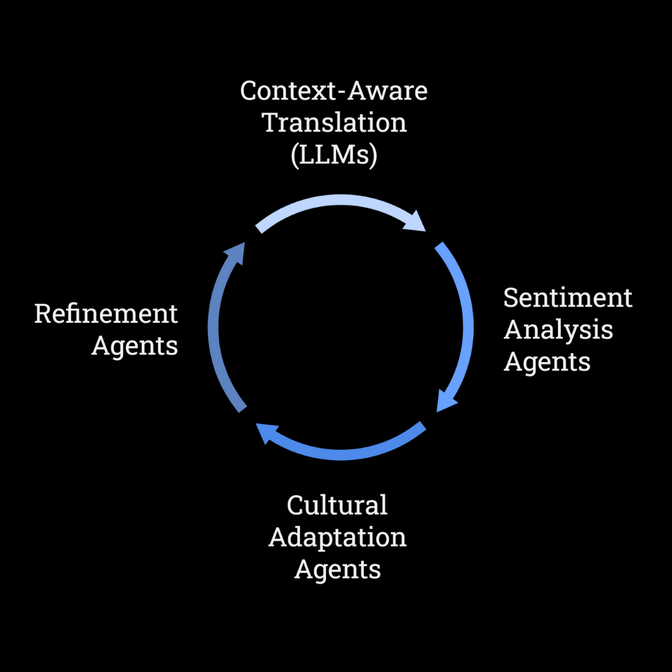
LLMs like Claude, Gemini, and ChatGPT drive context-aware translations that maintain cultural nuances. In OLabs, these models work alongside agents focused on sentiment analysis and cultural adaptation. These agents refine translations to capture the essence of the original content, particularly in complex dialogues and culturally sensitive topics.
✔️Text-to-Speech (TTS) with Emotional Nuance:
TTS technology has advanced in replicating human speech, including tone and cadence. However, it still falls short in capturing the full emotional range present in human performances. Despite these limitations, AI-driven voiceovers offer a scalable, cost-effective alternative to traditional dubbing, especially for large content volumes.
✔️Customization in Dubbing:
Ollang's Unique Voice Generation technology creates high-quality AI voices that maintain consistency across content while ensuring characters sound authentic within their context. This customization helps content owners meet audience demands and preserve brand integrity.
✔️Multilingual Capabilities for Global Reach:
AI-powered localization generates multilingual content quickly, which opens access to global markets at a fraction of the cost of traditional methods. Dynamic routing within OLabs selects the best AI models for specific languages and content types. This increases efficiency while maintaining accuracy and contextual relevance across languages.
✔️Collaboration Between AI and Humans:
AI has made significant strides, and human editors refine the final output. Ollang’s agentic workflow reduces reliance on human intervention by improving localization accuracy. The system integrates AI models that understand both language and context, which minimizes errors and ensures quality.
✔️The Market Opportunity: Expanding Accessibility
With the capability to localize content into 120 languages, OLabs lowers the barriers for global distribution.
② Real-World Implementation and Benefits
Moving from theory to practice, the benefits of AI localization become evident through real-world applications and industry insights.
✔️Enhancing Audience Immersion
Authentic, emotionally resonant localization is key to audience engagement. Can AI achieve this?
The answer is often yes. Consider modern AI voices. They have evolved beyond their early, robotic versions and can now closely mimic human speech, which makes them hard to distinguish.
As Jonathan Harrington, Professor of Phonetics and Digital Speech Processing at the University of Munich, explains, “In the last 50 years, and especially recently, speech generation and synthesis systems have become so good that it is often very difficult to tell an AI-generated and a real voice apart.”
While concerns over misuse remain valid, the application of AI voices in fields like customer service, localization, and healthcare has brought meaningful benefits. In dubbing, the debate isn’t about choosing between AI or human voices but about prioritizing quality.
Success with AI Localization Solutions:
By partnering with Ollang, a European-based OTT Platform streamlined localization processes, reduced costs, and improved quality using advanced AI solutions.
Ollang automated subtitling and captioning, while expert linguists refined machine translations. The Platform's sound engineers finalized localized audio, ensuring seamless integration.
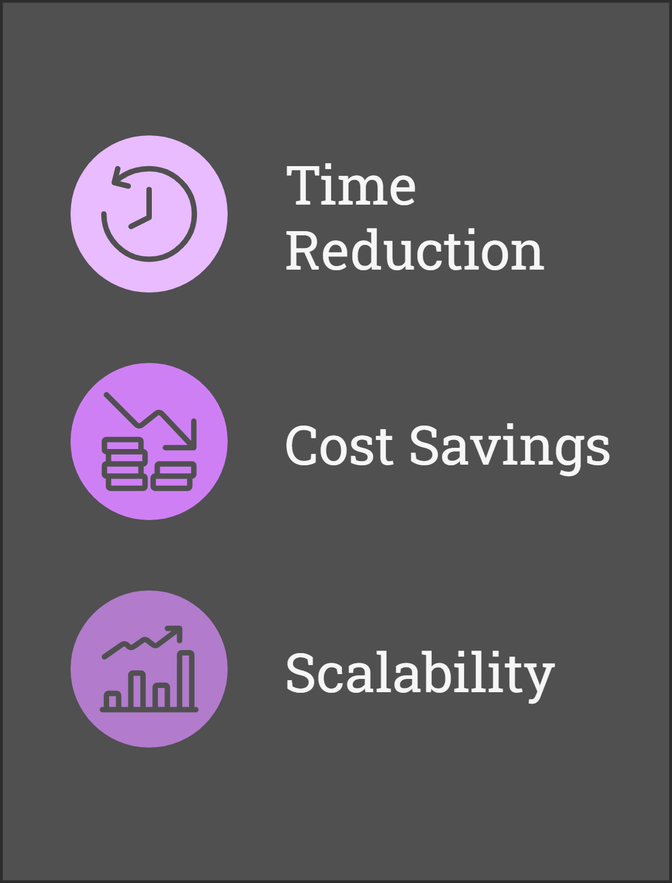
This collaboration reduced localization timelines by 5X, cut costs by nearly 6X, and enabled the platform to deliver localized content more efficiently to its customers, supporting a growing library and expanding global reach.
✔️AI Localization Saves Time and Money
By automating processes, AI localization reduces project timelines from weeks to just days. This makes it a valuable tool for industries like education, digital media, and regional streaming services with pressing deadlines.
The savings go beyond just time. For example, studio dubbing incurs high costs from studio space, specialized equipment, voice actor fees, and post-production editing.
Agentic localization, integrated into OLabs, breaks tasks into smaller, manageable components, assigns the most suitable AI tools for each. We enhance overall audience experience and make content accessible to everyone, including those who rely on audio and other non-visual methods.
➢ Case Study: Localizing a vast volume of documentary films
A digital media leader needed to localize a vast library of documentaries to meet global demand. Their real-time, event-driven content strategy required fast, efficient localization.
Collaborating with Ollang’s advanced AI localization technology, the Company localized over 600 hours of content in multiple languages, including Korean, Chinese, German, and Spanish. Automated workflows streamlined costs and optimized resources.
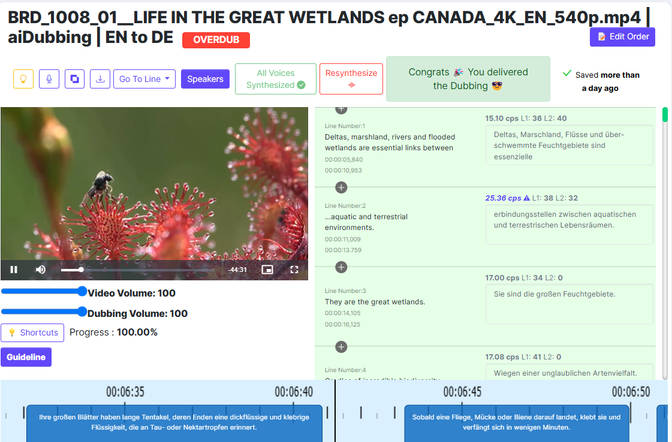
This ongoing partnership continues to empower them to meet high-volume demands tied to current events.
✔️Maintaining Consistency with AI Dubbing
Traditional localization methods often involve multiple teams and workflows, which can lead to inconsistencies in tone, style, and timing. AI-powered solutions address this by streamlining processes and ensuring uniformity across captions, subtitles, and voiceovers.
Case Study: Hybrid Localization Strategy
One of Italy’s top production houses, a valued long-term partner of Ollang, has been leveraging our subtitling and studio dubbing services for over a year. Recently, they incorporated AI localization into their workflows for a movie and several series.
For instance, in a 30+ episode series, we provided:
➼ Accurate subtitle translations tailored to the target audience.
➼ Unique AI voices that maintained consistent character tone.
➼ A streamlined workflow that reduced turnaround time.
➂ Pre-Trained, Cloned, Unique: Exploring AI Voice Varieties
With the practical benefits established through case studies, we’ll now see the various AI voice options that present distinct advantages for different projects.
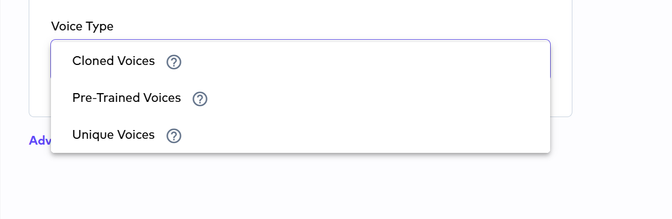
Ollang’s approach to voice synthesis emphasizes flexibility and quality:
Pre-trained Voices: These voices are drawn from trusted, high-quality AI systems like Resemble AI, ElevenLabs, Cartesia and WellSaid Labs. This option is ideal for projects that require fast and consistent dubbing.
Cloned Voices: This option replicates specific voices with the necessary permissions. Cloned voices are useful for projects where matching the original voice is essential for authenticity and audience engagement.
Unique Voices: Developed using Ollang’s proprietary synthesis technology, unique voices offer a natural sound without direct cloning. This option is especially useful for creating distinct characters tailored to different narratives or target demographics.
Choosing the best voice type depends on the genre and specific project needs. For instance, in an emotionally charged war-themed movie, where characters require depth and expression, unique voices are ideal.
On the other hand, for a single-narrator documentary, particularly when the narrator is off-screen, pre-trained voices offer a more efficient and consistent solution.
In Conclusion
Throughout this post, we have outlined how AI localization with multiagentic workflows benefits content owners.
We have also discussed that embracing AI is essential for adapting to better serve modern needs. Lastly, you’ve been introduced to three different AI voice types that our partners select based on their content needs.
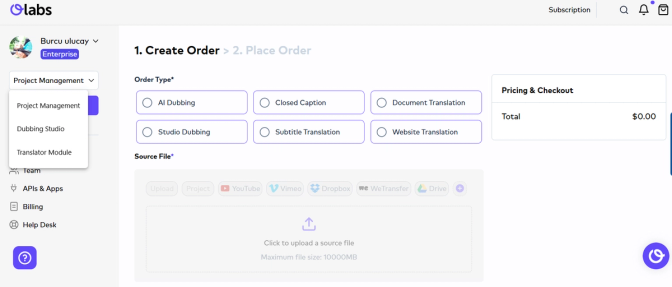
Our platform OLabs offers a comprehensive localization solution encompassing closed captioning, subtitling, and both AI and studio dubbing. This unified approach supports content owners in managing the complexities of multilingual distribution efficiently.
If you’re ready to take the next step, contact us here. For more information or a personalized consultation, reach out to us at info@ollang.com.
┈┈┈┈┈☟┈┈┈┈┈┈┈┈┈┈☟┈┈┈┈┈
You may be interested in:
Overcome Operational Limits and Expand Globally with AI Dubbing for Modern Content Owners