

Localization industry is undergoing a seismic shift, and artificial intelligence (AI) is at the heart of this transformation. As we ride this wave of change, let's explore how AI is not just reshaping traditional roles but creating new and exciting opportunities for translators and localization experts.
The Impact on Job Market: Adapting to Change
AI, undoubtedly, will make certain roles redundant, but it's also a creator of new possibilities.
Consider this: translators and localization experts are now in demand to train and manage AI-powered tools. Quality assurance for automated translations is another frontier where human expertise is irreplaceable. It's not about jobs being lost; it's about adapting and thriving in a changing landscape.
The emerging roles demand mastery in using AI effectively in localization workflows. It's not about fearing the change but embracing it and leveraging AI to enhance the quality and efficiency of language services.
The Human Element: Unmatched Capabilities in a Digital Age
Human element is irreplaceable in language services. Why? Because humans have an unparalleled capacity to understand cultural subtleties, ethical nuances, and complex contexts. As translators and localization experts embrace AI, they become not just linguists but cultural custodians, ensuring that language services remain deeply rooted in human understanding.
The third event in Think Global Forum's AI Roundtable series concluded with a powerful message – the imperative of continuous learning and adaptation for language professionals.In an AI-dominated era, experimentation with AI tools becomes crucial. Specializing in niche areas and showcasing value beyond mere translation is the key to thriving in this changing landscape. The message is clear: evolve or get left behind.
Alliance of Humans and AI: Crafting Masterpieces
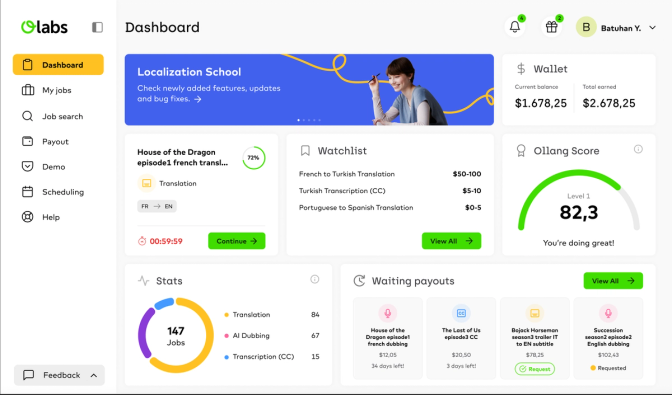
Translators, language experts, and voice artists are becoming allies with AI to create top-notch subtitle translations and dubbing work. The emergence of AI dubbing editors is on the horizon, and those who effectively use AI dubbing like OLabs will take the lead. Selecting suitable AI voices for each character, adapting vocal features for natural and humanlike dubbing – it's a collaboration that brings together the best of both worlds.
Subtitling in the AI Era: Streamlining Creativity
Subtitling, once a laborious starting point for every project, has transformed.
Thanks to AI, translators now receive considerably accurate machine translations as a foundation. From there, they weave their creative solutions, refining and revising these translations for greater accuracy.
It's a streamlined process that allows translators to focus on the artistic nuances rather than starting from scratch.
Final Remarks
The key is to embrace the synergy between humans and AI. The narrative is not one of replacement but of coexistence. AI is a tool, a partner that enhances our capabilities.
So, fellow language enthusiasts, let's ride this wave with confidence, continuously learn, adapt, and together craft masterpieces that transcend borders and languages. The future is here, and it's an exciting blend of human ingenuity and AI innovation.
You may also like...
🔸Artificial Intelligence: Can It Replace Human Expertise in Localization?
🔸AI & Localization: Challenges and Future Possibilities for LSPs
🔸Sustained Success: W4tch TV's Continued Journey in AI Dubbing