

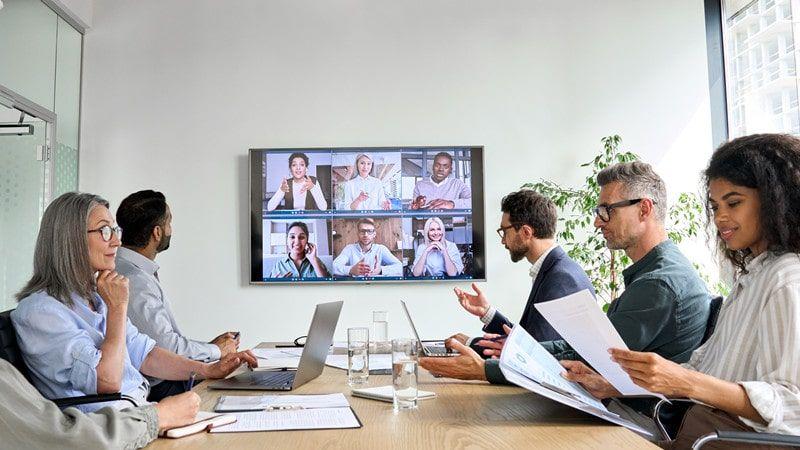
Top executives and HR professionals at a global company grappled with a puzzling challenge: a sharp decline in employee engagement. Extensive research revealed a potential solution—speaking in employees' native languages could significantly enhance engagement and productivity.
The problem lay in the fact that all corporate interactions occurred exclusively in English, the "official" language, impeding effective communication and goal alignment.
So, what should the company do next? The crucial first step involves recognizing key forms of corporate content that lend themselves to multilingual adaptation. Let's consider starting with visual content, such as training videos. From there, the focus should shift to formulating an optimal localization strategy, one that achieves seamless, high-quality video localization at scale.
This article aims to offer guidance for global enterprises grappling with similar challenges.
You're as global as you talk the language of your employees
Expanding a company's talent pool globally undoubtedly enriches its capabilities and skill sets. However, it necessitates the establishment of effective mechanisms to facilitate multilingual communication. Ensuring communication flows seamlessly across linguistic barriers is crucial for fostering understanding and engagement.
Consider the challenge faced by non-native speakers trying to grasp and retain information conveyed by the C-suite and other organizational leaders.
Wouldn't this impact their sense of belonging?
Could it not potentially hinder their processing of messages from management?
In such scenarios, subtitles prove invaluable, serving as aids that enhance comprehension, especially when confronted with diverse accents, dialects, or unfamiliar terms from various regions.
Choosing What to Localize
Identifying essential video content for localization is crucial. This includes materials that hold strategic importance and involves company-wide announcements.
➜ Employee trainings: Online learning has surged in popularity since the onset of the COVID-19 pandemic, and employees are increasingly drawn to companies that provide them with opportunities for professional development. These types of materials come in several formats such as internal training sessions, on-demand webinars and courses outsourced from third party e-learning platforms or trainers.
➜ Corporate Communication: Global companies engage in various corporate communication events that enhance company-wide alignment and transparency. These encompass a range of interactions, from C-level speeches and discussions to breakout sessions and small-group meetings.
Subtitling for Increased Employee Engagement and Better Learning Outcomes
The process of subtitling entails adding text to video content, synchronizing it with spoken dialogue or narration. This textual layer offers viewers a written representation of the audio, enhancing comprehension and accessibility.
Conventional subtitling methods which extensively depended on human intervention and manual procedures often deterred businesses from enhancing the linguistic accessibility of their videos to employees. Inconsistent translations, high costs, and extended delivery times were prevalent drawbacks.
However, the advent of AI-driven solutions has eradicated the hurdles that once hindered swift and accurate subtitling, making it a scalable and accessible practice.
Two Facets of Subtitles:
Subtitles manifest in two key forms:
➜ Multilingual Subtitle Translations
➜ Monolingual Closed Captions
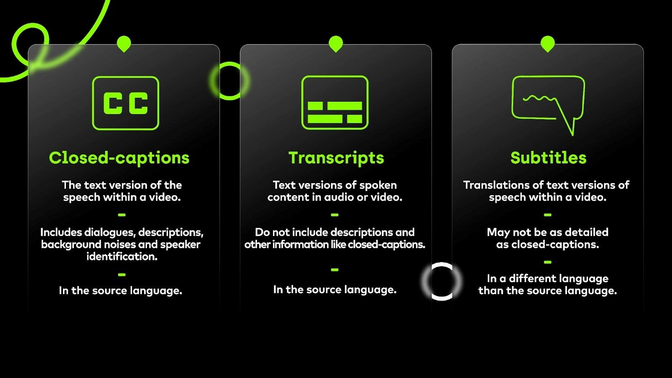
The image above illustrates the primary differences among various subtitle types. Additionally, we have an article that delves more comprehensively into this subject.
Benefits of Adding Subtitles to Corporate Training and Communication Videos
➊ Accessibility and Inclusion through Subtitle
Closed captions (CC) play a pivotal role in making content accessible for employees with hearing disabilities. These captions provide a text-based representation of audio cues, ensuring everyone can engage meaningfully with your videos.
For non-native speakers, they clarify accents and dialogue, ensuring seamless communication in training videos. Moreover, by localizing your videos through multilingual subtitling, you extend your reach to employees from different countries.
This improved accessibility not only aids in understanding but also enhances your company's reputation and brand awareness, positioning you as an advocate of inclusivity.
➋ Flexibility: Learning on Your Terms
Training can often be a time-consuming endeavor, particularly when it involves hours of tutorial videos. Subtitles add a layer of flexibility to training. Employees can watch videos in noise-sensitive environments without the need for headphones.
Without captions, learning is confined. With them, you empower your workforce to learn anytime, anywhere.
➌ Focused Learning, Better Outcomes
It's a straightforward principle: comprehending new concepts in an unfamiliar language can be daunting. If you want to ensure crucial concepts are thoroughly understood, delivering content in the learner's native language becomes a strategic investment to ensure employees extract the utmost value from videos and training sessions.
On the flip side, failure to provide subtitles can result in a disconnect between the course and employees. Distraction and waning interest follow suit.
By tailoring essential corporate video content to a diverse workforce, organizations equip all their employees – regardless of location – to learn efficiently. Enhanced learning experiences directly boost employee engagement and contribute sales and profits.
➍ Global Reach with a Personal Touch
Localizing content doesn’t merely facilitate learning processes; it's also about forging a personalized connection that resonates with employees' needs. This personalized touch underscores a dedicated workforce, a cornerstone in gaining a competitive edge in the global arena.
By ensuring every employee can access essential information in a language they understand, you cultivate a culture of inclusion. When employees have resources in their native languages, it shows their needs are valued, exemplifying a real commitment to diversity, equity, inclusion, and belonging (DEIB).
➎ From Subtitles to Dubbing in Corporate Videos
Monolingual closed captions and transcripts serve as the foundation for crafting multilingual video subtitles. With an array of multilingual subtitles at your disposal, you're prepared to venture into the next stage: creating scripts for dubbing.
Dubbing fosters a profound connection with the content, enabling participants to immerse themselves in both the visual and auditory aspects. This proves particularly effective in scenarios where visuals are vital, such as technical skill training.
Providing essential corporate videos through both subtitles and dubbing in various languages presents the most comprehensive and impactful approach. Nonetheless, subtitles tend to be more accessible, catering to those with hearing impairments and those who prefer silent viewing. Furthermore, subtitling offers a swifter and more cost-effective approach, aligning with both financial feasibility and efficiency objectives.
Finding The Right Solution Provider For Localization
Achieving accurate captions within budget limits remains a serious challenge, but technology provides a remedy. For a streamlined localization process, seek a vendor that provides a centralized, AI-driven localization platform like OLabs.
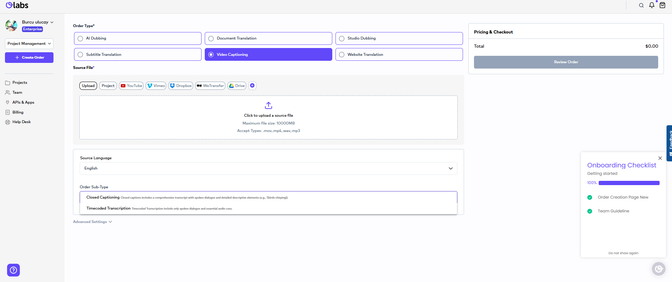
OLabs serves as a comprehensive solution for all content localization requirements. Its separate dashboards for translators, clients, and vendors cater to diverse user needs. Notable features include rapid order creation, advanced project tracking, team role assignments, assistance and request generation, as well as revisions and editing capabilities.
The inclusion of human translator review and checks further enhances the quality and accuracy of localized content, ensuring a cost-effective yet excellent localization experience.
We have a range of localization services at OLabs, including closed captions (CC), subtitling, AI dubbing, and dubbing. Since our focus has been on subtitles throughout this article, let's explore how you can add subtitles to your videos using OLabs.
Adding Subtitles By Using OLabs
① Create a new project
Once you're logged into Olabs, click the "Create" button located on the left side of your dashboard. Choose the "Subtitle" option for your project type.
At this stage, you can opt for a "Quick Order" for a single project or go for the "Advanced Order" to manage multiple projects. Proceed by uploading your video(s) or inserting an online video URL.
② Selecting Language Pairs
In this stage, determine the source and target languages for your project.You can select multiple target languages but note that the source language must be the same.
③ Selecting Quality Type
Our AI Agents will transcribe and translate dialogues and video elements. For edits, you can either take on it or request revision from Ollang's professional translators.
④ Finalizing the Order
Move forward by clicking the "Add to Cart" button to finalize your order. Here, you'll find project details. Confirm your order summary on the right side, then click "Proceed to Checkout."
The Rest Is in Our Hands
From this point on, our AI-powered localization software collaborates with skilled language professionals to work on your video. Once your subtitles are ready, we'll notify you through email. Simply access your OLabs dashboard to download your subtitles in available formats.
Should you want your subtitles embedded directly into your video, choose the "request subtitle embedding" option within the download link. Once the process concludes, you'll receive an email containing the download link and also find the download option in the dropdown list.
The challenges of subtitling and dubbing are a thing of the past, thanks to technological advancements like those offered by Ollang. By incorporating human revision and checks, the AI-generated content is refined, yielding exceptional results.
Fill out the form to consult with our partnership team on localization needs.