

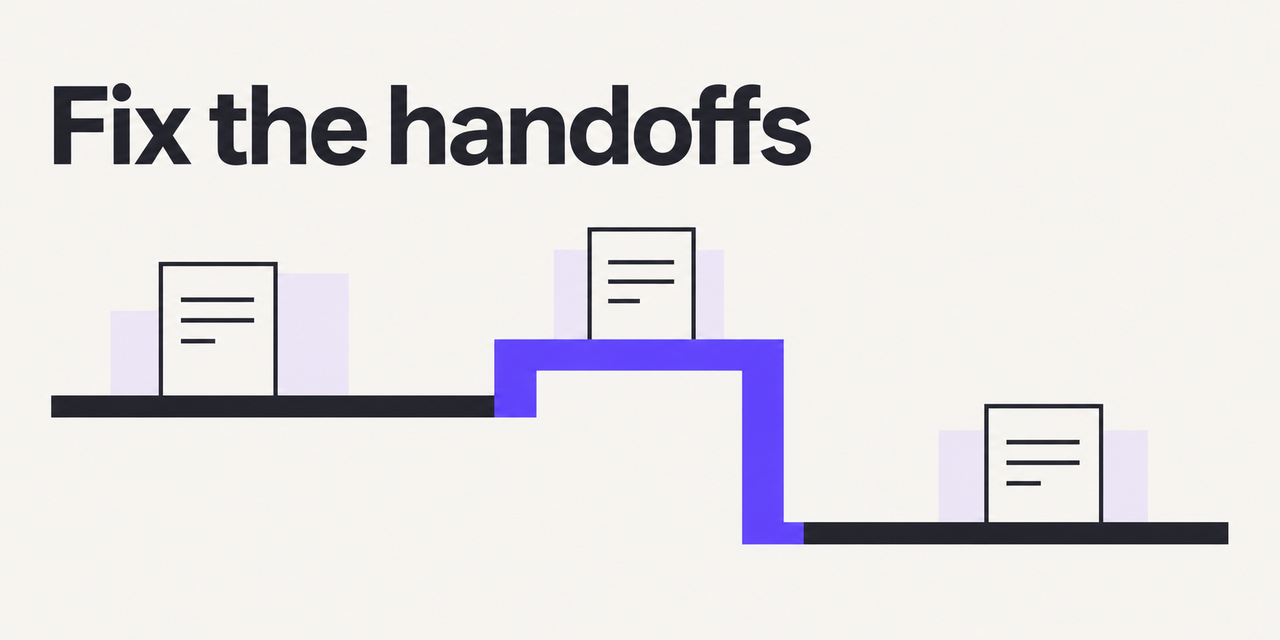
Content owners and streaming platforms need accessible, culturally accurate content across global markets. Most struggle with speed, quality, and cost demands. Critical messages fail to reach audiences when captions are inaccurate or missing.
What should open new markets and provide genuine accessibility instead becomes a costly roadblock.
Three key factors create this situation:
⚫ Vendor silos: Disconnected teams introduce errors and delays.
⚫ Inadequate technology: Generic tools collapse under complex content demands.
⚫ Speed vs. quality tradeoff: Rush and sacrifice accuracy, or delay and miss market windows.
Leaders responsible for localization need a change in current business practices.
Below, we examine why general-purpose AI tools and human-heavy processes underperform and how agentic AI translation overcomes these limitations, supported by evaluations, benchmarks, and real-world examples.
The three problems breaking your localization workflow
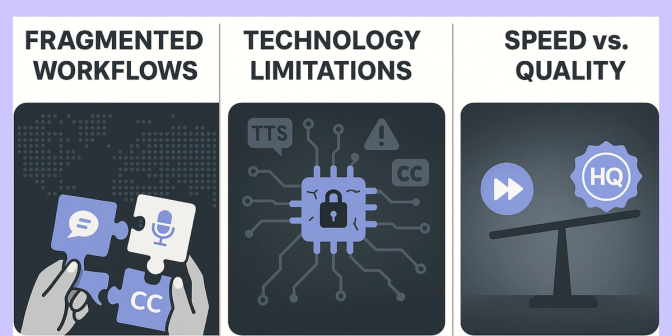
① Fragmented processes and vendor complexity
‣ Manual handoffs: Content shuffled between teams introduces typos and late deliveries.
‣ Limited visibility: Errors like mistranslations remain hidden until launch day.
‣ Multiple vendors: Subtitles, dubbing, and reviews split across companies create uneven quality.
‣ Scaling issues: Adding languages requires managing more project coordination demands.
Result: Extended timelines, inflated costs, and teams diverted from strategy to manage logistics.
② Technology limitations
‣ Basic AI flaws: General AI misses cultural references, industry terms, and audio-video synchronization.
‣ Integration problems: Tools demand heavy setup and clash with workflows.
‣ Rigid systems: Standard tools can’t adapt to brand voice or specific terminology.
Result: Inconsistent output derails projects.
③ Speed & Quality dilemma
‣ Rushed automation: Machine translations produce errors that confuse viewers.
‣ Slow manual work: Human efforts ensure quality but take 5X longer for large volumes.
Result: Content owners must choose between meeting deadlines with poor quality or missing market windows with more accurate content.
These problems demand a fundamentally different approach to localization - one that eliminates fragmentation, overcomes technology limitations, and resolves the speed-quality dilemma.
How Ollang's agentic AI eliminates localization bottlenecks
Ollang’s agentic AI translation uses multiple task-oriented AI agents working together to deliver results that surpass single-model approaches and traditional methods. This changes how localization problems get solved.
Content owners launch precise captions that make content accessible for global audiences. Companies cut costs and accelerate timelines, while localization teams redirect efforts from corrections to creative strategy.
Inside Ollang's M3: How it works
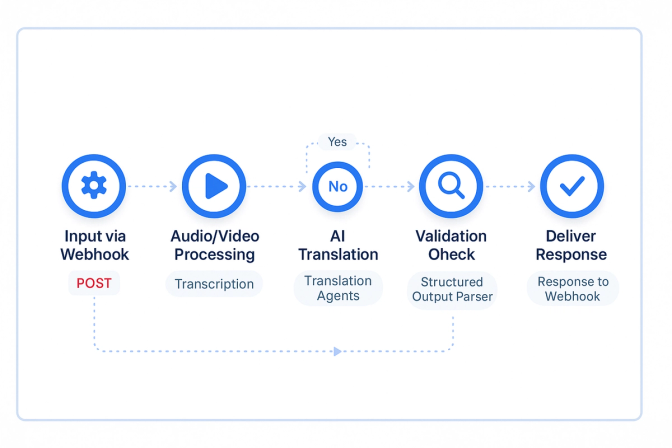
In the multilingual multimodal and multiagent (M3) AI, specialized agents handle distinct tasks, from video analysis to cultural alignment, and collaborate to deliver precise, compliant content across text, audio, and video formats.
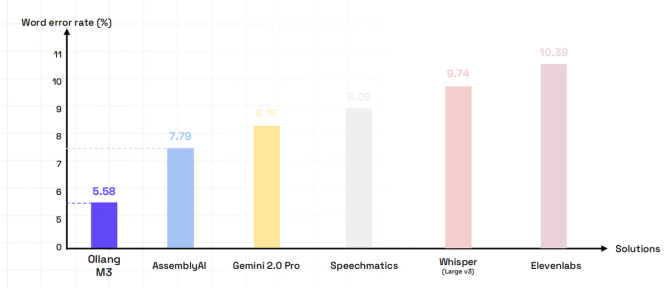
⚫ Video understanding agent: This agent dissects video content, transcribes dialogue, and identifies sounds like “[rain patters]” despite noise or acoustic challenges.
Together with other agents, it helps the M3 framework achieve a 5.58% word error rate (the closer to 0%, the better) and outperforms well-known speech-to-text providers for complex content.
⚫ Cultural adaptation agent: It uses cultural databases to swap idioms or imagery that might offend. For a retailer, for example, it adjusts marketing videos to resonate in 20 markets and avoids cultural missteps that alienate customers.
⚫ Sentiment alignment agent: This agent preserves a story’s emotional tone across languages to keep humor or drama intact. It helps filmmakers maintain a series’ impact in markets like Japan, where subtle tone shifts matter.
⚫ Multimodal judge agent: It checks that text, audio, and video align perfectly and catches mismatches like unsynced subtitles.
⚫ Data transformation agent: This agent converts content between formats, like transcripts into timed subtitles. Localization teams handle diverse content types without manual rework to save resources.
⚫ Feedback loops and dynamic routing: Critic agents spot errors instantly as routing selects the best model for each task.
Impact: The M3 framework reduces human editing requirements by 76% compared to traditional machine translation outputs. Industries from media to education now access multiple markets simultaneously, while accurate captions and SDH meet accessibility standards required by broadcasters, digital media distributors, and regulated industries.
Real-World results for AI-powered localization
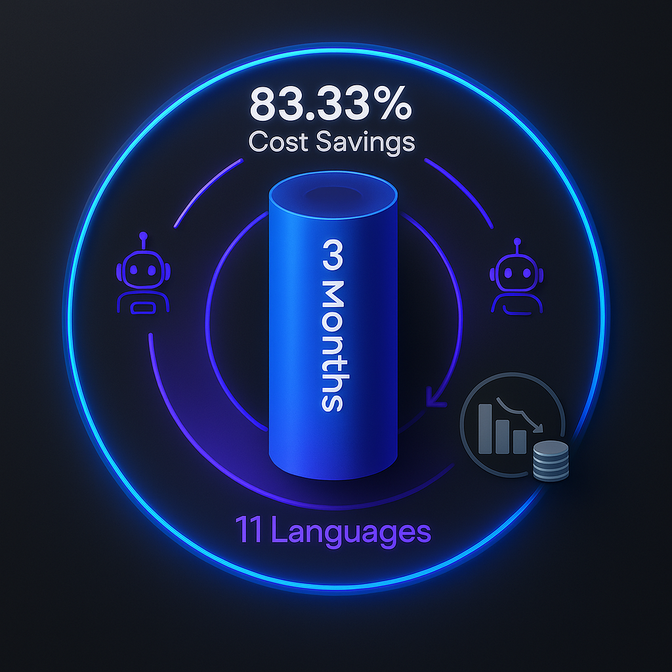
⚫ Video platform scale: 11 languages in 90 days
A video platform localized +10,000 short videos into 11 languages within three months to enter new markets. The M3 framework produced captions and subtitles in German, Japanese, Turkish, and more. Our partner saved over 80% of costs compared to traditional methods, bringing per-minute localization costs significantly below industry average rates.
⚫ 60,000 titles made accessible for a digital reading platform
A reading platform made 60,000 titles accessible with captions, subtitles, and audio descriptions for visually and hearing-impaired users. Ollang integrated AI-driven localization, which included audio descriptions, into their workflow. The platform reached diverse audiences, which included those with disabilities, without delays.
⚫ 600+ hours documentary localized under deadline
A digital media company localized over 600 hours of documentaries into multiple languages, including Korean, Spanish, Italian, and Hindi, under tight budgets and schedules. Ollang provided accurate captions, subtitles, and AI-dubbed audio, edited for quality. Dubbed videos generated 69% more revenue and reached broader global audiences.
AI dubbing: fast, natural voice solutions
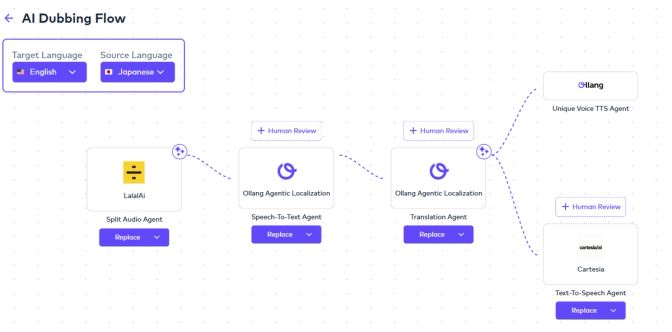
Beyond solving the core localization challenges discussed above, Ollang's AI-powered framework also addresses another critical pain point: dubbing efficiency.
Studio dubbing delays projects with high costs and complex management, while basic AI dubbing produces unnatural voices that disrupt audience experience.
Ollang’s M3 framework uses agentic AI to create captions and subtitles, which AI voice agents convert into natural speech with pretrained, cloned (with consent), or unique AI voices. AI editors adjust lip-sync, volume, and timing to match mouth movements.
Our partners meet all localization requirements through a single platform, accessing captions, subtitle translations, AI dubbing, and studio dubbing services on demand.
Why companies choose Ollang for localization
Localization fails when vendor silos, weak AI tools, and slow processes block global delivery. Ollang’s M3 framework uses agentic AI for translation to overcome these obstacles and deliver precise captions, subtitles, and natural AI dubbing. Media firms and platforms cut costs and reach audiences worldwide, as teams focus on strategy.
Contact our partnerships team to tackle your localization challenges with a solution that delivers on speed, quality, and cost-efficiency simultaneously.
Q&A: Addressing Your Localization Concerns
① How does agentic AI differ from traditional or standard AI?
Traditional AI uses single models that miss cultural depth and video nuances. Ollang's Agentic AI uses specialized AI agents for translation, achieves 98.9% accuracy for German subtitles (based on human evaluation of video content), and surpasses models like GPT-4o and Gemini 1.5 Pro.
② Can Ollang meet EAA standards?
Yes, our agentic AI translation delivers >95% accurate SDH and closed captions, meets EAA, ADA, and ACA requirements, and provides accessibility features for global audiences across devices and platforms.
③ How does Ollang balance speed, quality, and cost?
The multiagentic AI cuts human effort by 76%, reduces costs by over 80%, delivers high-quality content faster, and enables platforms or broadcasters to localize a series in days instead of weeks to meet tight deadlines. See our blog post that covers strategies to maximize quality while reducing localization costs.
④ Is human editing still needed?
Through continuous feedback and iteration, Agentic AI produces significantly more accurate output than machine translations or single LLM solutions. This minimizes the need for human edits. Translators focus on refining cultural nuances and revising domain-specific content for markets in e-learning, finance, retail, and other specialized sectors.